Select Language
In the vast world of material handling and logistics, mobility is key. While household furniture might use small, lightweight wheels, factories, warehouses, and heavy machinery require a far more robust solution. This is where industrial casters come into play. Unlike their light-duty counterparts, industrial casters are engineered for extreme durability, high weight capacity, and performance in the most demanding environments.
Industrial casters are designed to support heavy loads, often ranging from 300 pounds (136 kg) to several thousand pounds per caster. They are the backbone of mobile equipment in manufacturing plants, distribution centers, and workshops.
Key Features:
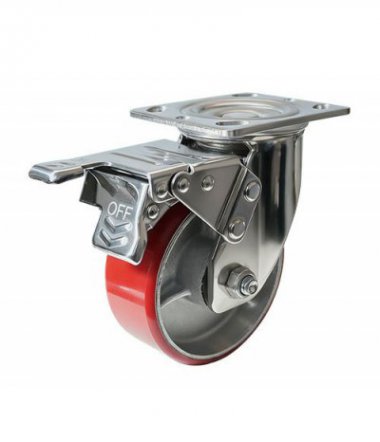
Heavy-Duty Construction: The forks (yokes) are typically made from thick, forged steel or heavy-gauge stamped steel to resist bending and breaking under pressure.
High-Capacity Wheels: Wheels are constructed from materials like cast iron, forged steel, polyurethane treads on aluminum cores, or phenolic resin. These materials are chosen for their ability to carry massive loads without deforming.
Precision Bearings: To ensure smooth movement even under heavy loads, industrial casters utilize precision ball bearings or roller bearings in both the swivel raceway and the wheel hub.
Impact Resistance: They are built to withstand shock loads, impacts from drops or collisions, and constant use.
Industrial casters are indispensable in sectors where moving heavy equipment safely and efficiently is critical. Typical applications include:
Aerospace and Automotive Manufacturing: Moving airplane parts or car chassis.
Warehousing and Logistics: Heavy-duty pallet jacks, platform trucks, and stackers.
Food Processing Plants: Stainless steel casters that resist corrosion and meet hygiene standards.
Medical Equipment: Large diagnostic machines and hospital beds.
Scaffolding and Construction: Ensuring stable mobility for heavy work platforms.
Producing high-quality industrial casters requires advanced technology, strict quality control, and extensive industry experience. It is crucial for businesses to partner with reliable manufacturers who understand the technical specifications required for heavy-load applications.
One such leading enterprise is China FFIBU Casters Co., Ltd. Founded in 2002 and headquartered in Zhongshan, China, FFIBU has established itself as a professional manufacturer specializing in a wide range of casters, including high-performance industrial series. With a massive production facility spanning 30 acres and over 20,000 square meters of workshop space, the company leverages more than ten automated production lines to ensure consistency and precision.
FFIBU’s commitment to quality is evident in its rigorous testing procedures, which cover everything from raw material inspection to final product performance. Their industrial casters are known for their robustness and reliability, serving markets across Europe, the Americas, the Middle East, and Southeast Asia. Whether a client needs heat-resistant casters for a bakery or extra-heavy-duty casters for an automotive assembly line, companies like FFIBU provide tailored solutions that meet stringent international standards.
Industrial casters are far more than just wheels; they are critical components that enhance productivity, reduce manual labor, and improve safety in industrial settings. By understanding their construction and applications—and sourcing them from reputable manufacturers like China FFIBU Casters Co., Ltd.—businesses can ensure their operations run smoothly and efficiently, even under the heaviest of loads.
 中文简体
中文简体  English
  Español
  العربية
  Français
  Русский
  Português
  Deutsch
  日本語
日本語  한국어
한국어  Tiếng Việt
  हिन्दी
  Italiano
  Nederlands
  Türkçe
  Polski
  ไทย
ไทย  Română
  বাংলা
বাংলা  Українська
  עברית
עברית  Lietuvių
  Bahasa Indonesia
  Svenska
  Magyar
  Dansk
Dansk  Suomi
Suomi  Čeština
  Ελληνικά