Select Language
In the world of industrial manufacturing and logistics, casters are often the unsung heroes that keep operations moving. However, the failure of a single caster can lead to equipment damage, workplace injuries, and significant operational downtime. To prevent such scenarios, rigorous testing is not just a recommendation—it is a necessity.
For businesses looking for reliable mobility solutions, understanding these testing protocols is crucial. China FFIBU Casters Co., Ltd. emphasizes strict adherence to international testing standards to ensure that every product delivered meets the highest benchmarks of safety and performance.
The primary function of a caster is to bear weight. Testing in this category ensures the product can handle both stationary and moving loads.
Static Load Test: This test verifies the caster's ability to withstand weight without moving. The caster is fixed to a platform and subjected to a force (often 1.5 to 3 times the rated load) for a set period (e.g., 24 hours). A qualified caster should show no structural deformation exceeding 3% of the wheel diameter and must retain its rolling function after the load is removed .
Dynamic Load Test: This simulates real-world usage where the caster is rolling under weight. It involves continuous rolling cycles (sometimes up to 100,000 cycles) to check for fatigue, bearing failure, or axle breakage .
In real-world environments, casters often encounter obstacles like thresholds, bumps, or sudden drops.
Vertical Impact Test: A weight (typically 5kg) is dropped from a specific height (e.g., 200mm) onto the wheel edge to simulate the shock of hitting an obstacle or a drop. The caster must remain intact without any parts separating .
Obstacle Impact Test: The caster is rolled into a fixed obstacle at a specific speed to test the structural integrity of the fork and the wheel material’s resistance to chipping or debonding .
This evaluates how the caster holds up over time, specifically the tread material and the swivel mechanism.
Reciprocating Wear Test: This test simulates daily rolling on both obstacle-free surfaces and surfaces with small obstructions (2mm-3mm high). It measures the wheel's ability to withstand thousands of forward and backward movements without the tread flaking or the swivel mechanism seizing .
Abrasion Resistance: Wheels are rolled against abrasive surfaces (like sandpaper) to measure material loss over distance, ensuring the wheel won't wear down too quickly in industrial settings .
Casters are frequently used in harsh conditions, from freezing cold storage to corrosive wash-down areas.
Salt Spray Test: To test corrosion resistance, casters are exposed to a saline mist (per standards like ASTM B117). The duration (e.g., 48 to 96 hours) determines the quality of the plating or coating. High-quality finishes should show no red rust within the specified timeframe .
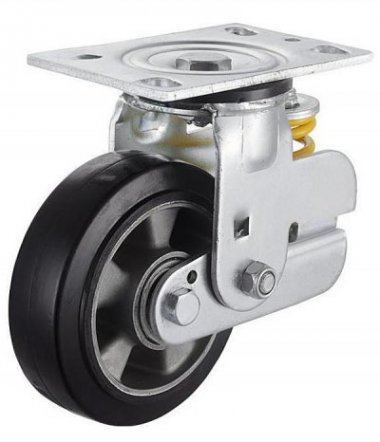
Temperature Resistance: Casters are tested in extreme heat or cold to ensure the grease doesn't dry out and the wheel material (polyurethane, rubber, nylon) doesn't become brittle or soften excessively .
For casters equipped with brakes, stopping power is a critical safety feature.
Brake Efficiency Test: This measures the force required to engage the brake and the holding power on slopes. A caster must remain stationary on an inclined plane (usually 10° to 15°) under rated load to pass .
Rolling and Swivel Resistance: Tests measure the initial force required to start the caster moving and the force required to keep it moving. Lower resistance means easier maneuverability for the operator .
For environments sensitive to electrostatic discharge (ESD), such as electronics manufacturing or explosive atmospheres, specific tests are required.
Resistance Measurement: Using an insulation resistance tester, the electrical resistance between the caster and the ground is measured.
Conductive Casters: Resistance Ohms.
Antistatic Casters: Resistance between and Ohms .
Selecting a caster involves more than just checking the load capacity; it requires an understanding of the environmental and operational stresses the product will face. By choosing a manufacturer that adheres to these rigorous testing methods—such as China FFIBU Casters Co., Ltd.—businesses can ensure they are investing in equipment that is safe, durable, and reliable.
 中文简体
中文简体  English
  Español
  العربية
  Français
  Русский
  Português
  Deutsch
  日本語
日本語  한국어
한국어  Tiếng Việt
  हिन्दी
  Italiano
  Nederlands
  Türkçe
  Polski
  ไทย
ไทย  Română
  বাংলা
বাংলা  Українська
  עברית
עברית  Lietuvių
  Bahasa Indonesia
  Svenska
  Magyar
  Dansk
Dansk  Suomi
Suomi  Čeština
  Ελληνικά