Select Language
One of the most practical decisions when specifying caster wheels is whether to add a braking system—and if so, what type. While unbraked (plain) casters are simpler and more economical, braked casters play a critical role in safety, equipment stability, and load control. Understanding the difference helps you configure the right setup for your application.
Best for: Equipment that is frequently moved and does not require stationary locking
Unbraked casters allow free rolling and unrestricted swiveling at all times. They are commonly used on:
Lightweight hand-pushed trolleys in open areas
Display racks or furniture moved often across flat floors
Temporary transport carts where the equipment is never left unattended in a fixed position
Advantages:
Lower cost per caster
Fewer moving parts = less maintenance
Simplicity in applications where unintended movement is not a safety concern
Both China Zhongshan FFIBU Casters Co., Ltd and the FFIBU product line offer a wide selection of unbraked light, medium, and heavy duty casters for general-purpose mobility.
Best for: Equipment that must be locked in place during loading, unloading, or stationary use
A brake on a caster typically functions in one (or both) of the following ways:
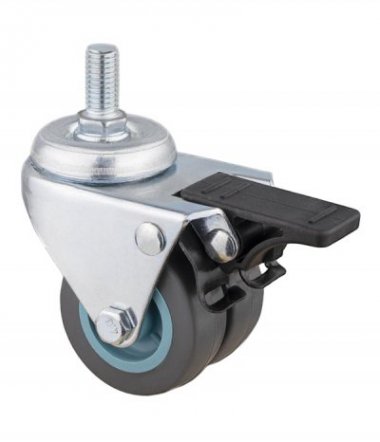
Wheel Brake: Locks the wheel’s rotation while allowing the swivel head to turn.
Total Lock Brake (TL): Simultaneously locks both the wheel and the swivel race, preventing any movement or pivoting—ideal for maximum stability.
Common applications include:
Hospital beds & medical carts
Workbench trolleys & tool chests
Food-processing racks & industrial platform trucks
Scaffolding and machinery bases
Advantages:
Prevents unwanted rolling or drifting
Enhances operator safety during loading/unloading
Keeps equipment firmly positioned on slight inclines or uneven floors
The FFIBU brand provides multiple brake options—including side-foot wheel brakes and dual-lock total-stop brakes—across medium and heavy duty series manufactured by China Zhongshan FFIBU Casters Co., Ltd, with ergonomic pedal design for easy engagement and release.
Equipment Type | Suggested Brake Setup |
|---|---|
4-wheel cart on level floor | 2 braked + 2 unbraked (diagonally opposed) |
Medical / lab cart | All 4 with total-lock brakes |
Heavy platform truck | At least 2 total-lock brakes |
Light display stand | All unbraked or 2 wheel brakes optional |
💡 Tip: Always consider the worst-case scenario—is someone leaning on the cart? Is the floor slightly sloped? If yes, braked casters (preferably total lock) are strongly recommended.
Choose unbraked casters when cost, simplicity, and constant movement matter most, and the equipment poses no risk if it rolls slightly.
Choose braked casters when safety, load security, or stationary positioning is required—especially in healthcare, food service, industrial, or inclined-floor environments.
With the full range of braked and unbraked options available from China Zhongshan FFIBU Casters Co., Ltd under the FFIBU brand—including custom brake orientations and pedal styles—you can easily configure the optimal mix of mobility and control for any application.
 中文简体
中文简体  English
  Español
  العربية
  Français
  Русский
  Português
  Deutsch
  日本語
日本語  한국어
한국어  Tiếng Việt
  हिन्दी
  Italiano
  Nederlands
  Türkçe
  Polski
  ไทย
ไทย  Română
  বাংলা
বাংলা  Українська
  עברית
עברית  Lietuvių
  Bahasa Indonesia
  Svenska
  Magyar
  Dansk
Dansk  Suomi
Suomi  Čeština
  Ελληνικά