Select Language
In environments where static electricity poses a risk to sensitive electronics or flammable materials, standard casters are not enough. Conductive casters (also spelled conductor casters) are a specialized type of wheel assembly designed to safely dissipate static electricity buildup, preventing electrostatic discharge (ESD).
Unlike standard casters that act as insulators, conductive casters create a controlled path for electrical current to flow from the cart or equipment down to the grounded floor, thereby neutralizing static charges.
The principle behind conductive casters is simple: they are constructed from materials that allow electrons to flow freely.
Material Selection: The wheels are made from inherently conductive materials, such as special compounds of rubber, polyurethane, or thermoplastic rubber (TPR) mixed with carbon black or other conductive fillers.
Continuous Path: The entire caster assembly—from the wheel tread through the bearing and into the metal housing—is designed to maintain electrical continuity.
Grounding: When the caster rolls on a grounded floor (like conductive ESD flooring), any static charge generated by the movement of the cart is immediately transferred to the floor, preventing sudden discharges.
It is important to distinguish between Conductive and Static Dissipative:
Conductive Casters: Have a lower resistance (typically less than 10⁴ ohms). They provide a rapid path to ground and are used in areas with explosive atmospheres or highly sensitive equipment.
Static Dissipative Casters: Have higher resistance (typically between 10⁵ and 10⁹ ohms). They slow down the discharge rate, which is often preferred for protecting delicate microchips from sudden current spikes.
Conductive casters are mission-critical components in industries where static control is a priority:
Electronics Manufacturing: Moving printed circuit boards (PCBs), microchips, and server components without damaging them via ESD.
Cleanrooms: Used on workbenches and transport carts in semiconductor and pharmaceutical cleanrooms to prevent static from attracting dust particles.
Explosive Environments: Essential in facilities handling flammable liquids, gases, or dust (e.g., paint shops, chemical plants) where a single spark could cause an explosion.
Healthcare: Used in hospitals for sensitive diagnostic equipment and in operating rooms.
To function correctly, conductive casters must be paired with compatible flooring. A conductive caster rolling on a standard carpet (which is an insulator) will not be effective. Therefore, these casters are almost always used on ESD-safe flooring systems that are properly grounded.
Common wheel materials for conductive casters include:
Conductive Rubber: Provides good floor protection and conductivity.
Conductive TPR (Thermoplastic Rubber): Offers a balance of elasticity, durability, and electrical properties.
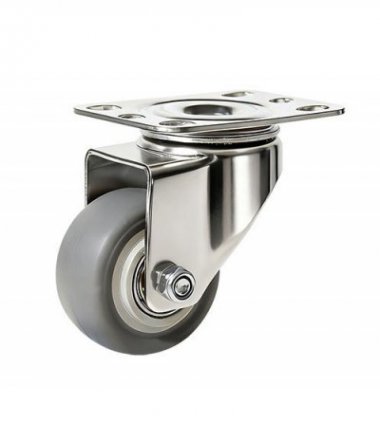
Pressed Steel Yokes: The metal fork of the caster is typically zinc-plated or stainless steel to prevent corrosion and maintain conductivity.
Since the electrical properties of the caster are just as important as its mechanical strength, manufacturing consistency is vital. A poorly mixed batch of conductive rubber can result in "hot spots" or areas with insufficient conductivity, rendering the caster ineffective.
This is where experienced manufacturers make a difference. China FFIBU Casters Co., Ltd., established in 2002, is a professional caster manufacturer that produces a wide range of specialized casters, including high-quality conductive and anti-static series. Operating from a 30-acre facility in Zhongshan, FFIBU employs strict quality control measures to test the resistivity of each batch of wheel compounds. Their conductive casters are engineered to meet international ESD standards, ensuring reliable performance for clients in the electronics, automotive, and medical industries across Europe, the Americas, and Southeast Asia.
In summary, conductive casters are not defined by their shape or size, but by their material composition and electrical function. They are a critical safety component designed to mitigate the risks associated with static electricity. By providing a safe path to ground, these casters protect sensitive electronics, prevent data loss, and reduce the risk of fire or explosion in hazardous environments. When selecting them, it is essential to source from technically proficient manufacturers like China FFIBU Casters Co., Ltd. to ensure compliance with strict ESD requirements.
 中文简体
中文简体  English
  Español
  العربية
  Français
  Русский
  Português
  Deutsch
  日本語
日本語  한국어
한국어  Tiếng Việt
  हिन्दी
  Italiano
  Nederlands
  Türkçe
  Polski
  ไทย
ไทย  Română
  বাংলা
বাংলা  Українська
  עברית
עברית  Lietuvių
  Bahasa Indonesia
  Svenska
  Magyar
  Dansk
Dansk  Suomi
Suomi  Čeština
  Ελληνικά