Select Language
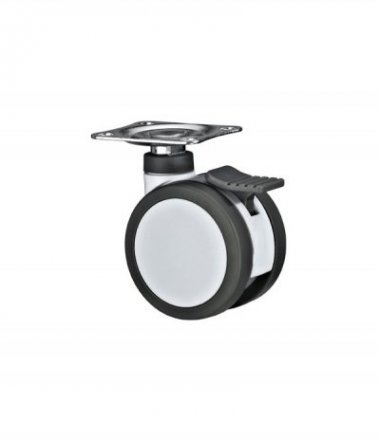
In the diverse world of material handling, selecting the right wheel material is crucial for efficiency, cost-effectiveness, and floor protection. While rubber and polyurethane offer softness and grip, and nylon provides toughness, PP (Polypropylene) casters occupy a unique niche. Known for their rigidity, cleanliness, and chemical resistance, PP casters are a staple in specific industrial and commercial environments.
This article breaks down the core advantages of Polypropylene casters and identifies the ideal conditions for their use, illustrating why manufacturers like China FFIBU Casters Co., Ltd. continue to produce high-quality PP series for global markets.
Polypropylene (PP) is a thermoplastic polymer known for its semi-crystalline structure. Unlike elastomers (like rubber or TPR), PP is a rigid plastic. This fundamental property dictates its performance: it does not flex or absorb shock like softer wheels, but instead offers exceptional hardness and stiffness.
PP casters are not designed for comfort or quietness; they are engineered for durability, hygiene, and chemical resilience. Their primary benefits include:
Superior Chemical Resistance: This is the standout feature of PP. Polypropylene is highly resistant to a wide range of acids, alkalis, solvents, and cleaning agents. It will not corrode or degrade when exposed to most chemicals that would destroy rubber or polyurethane wheels.
Hygienic and Easy to Clean: PP wheels have a non-porous surface that prevents the absorption of water, oils, and bacteria. They are easy to wash down and sterilize, making them a preferred choice in sterile environments.
High Rigidity and Load Capacity: Due to their stiffness, PP wheels do not deform under heavy loads. This allows them to support significant weight without "going flat," making them suitable for medium-to-heavy-duty applications.
Low Moisture Absorption: Unlike nylon (which absorbs moisture and swells), PP has virtually zero moisture absorption. This ensures dimensional stability even in wet or high-humidity environments.
Cost-Effectiveness: Polypropylene is an economical material, making PP casters one of the most budget-friendly options for heavy-duty applications.
To provide a balanced view, it is important to note the drawbacks of PP:
No Shock Absorption: Being rigid, PP wheels transfer shocks and vibrations directly to the cart and the operator. They are unsuitable for fragile cargo.
Hard and Noisy: They roll loudly on hard floors and can be difficult to push manually over uneven surfaces.
Poor Grip: On smooth, wet floors, PP wheels may slide rather than grip.
Given their properties, PP casters excel in the following settings:
Chemical Plants & Laboratories: Transporting containers of acids, solvents, or cleaning chemicals where wheel degradation is a risk.
Food & Beverage Processing: Ideal for washdown areas where equipment is hosed down frequently. White PP casters are non-marking and compliant with hygiene standards.
Pharmaceutical Manufacturing: Used on mobile equipment in cleanrooms and production lines where sterility and chemical resistance are paramount.
General Industrial Carts: Perfect for heavy tool carts, material bins, and dollies in factories with smooth concrete floors, especially where oils or coolants might be spilled.
While PP is an economical material, the performance of the caster depends entirely on the precision of the molding process and the quality of the bearings used. Poorly molded PP wheels can have internal stresses leading to cracking, while substandard bearings create excessive rolling resistance.
This is why partnering with an experienced manufacturer is essential. China FFIBU Casters Co., Ltd., established in 2002, utilizes advanced injection molding technology within its 30-acre facility in Zhongshan to produce structurally sound PP casters. Their automated production lines ensure consistent wall thickness and material integrity. Furthermore, FFIBU equips these casters with high-precision bearings to minimize the rolling resistance inherent to the rigid PP material, delivering a product that is both durable and functional for clients in Europe, America, and Southeast Asia.
PP (Polypropylene) casters are the workhorse of chemically aggressive and hygienic environments. They trade comfort and noise reduction for unmatched chemical inertness, rigidity, and ease of cleaning. When your application involves exposure to harsh substances or requires frequent sterilization, PP is often the optimal—and safest—choice. By sourcing from reputable manufacturers like China FFIBU Casters Co., Ltd., businesses can acquire robust PP casters that withstand the harshest conditions while maintaining reliable mobility.
 中文简体
中文简体  English
  Español
  العربية
  Français
  Русский
  Português
  Deutsch
  日本語
日本語  한국어
한국어  Tiếng Việt
  हिन्दी
  Italiano
  Nederlands
  Türkçe
  Polski
  ไทย
ไทย  Română
  বাংলা
বাংলা  Українська
  עברית
עברית  Lietuvių
  Bahasa Indonesia
  Svenska
  Magyar
  Dansk
Dansk  Suomi
Suomi  Čeština
  Ελληνικά