Select Language
In the world of material handling and mobility solutions, a caster is only as reliable as its braking system. Whether it is a heavy-duty industrial cart or a sensitive medical device, the ability to stop and stay stationary is paramount for safety. This is where Caster Brake Fatigue Testing plays a critical role. This rigorous procedure is designed to simulate the long-term wear and tear of braking mechanisms, ensuring they function flawlessly even after thousands of cycles.
The primary goal of brake fatigue testing is to evaluate the durability and effectiveness of a caster’s braking system over repeated uses. In real-world applications, equipment such as hospital beds, supermarket trolleys, and factory carts are frequently stopped and started. A failure in the brake mechanism—due to worn-out components or structural fatigue—can lead to catastrophic accidents, equipment damage, or workplace injuries.
By subjecting casters to thousands of locking and releasing cycles, manufacturers can identify potential points of failure, such as:
Mechanical Wear: Degradation of the pedal, lever, or gear mechanism.
Spring Fatigue: Loss of tension in the spring that engages the brake.
Material Deformation: Bending or cracking of the fork or brake shoe.
To ensure consistency and reliability, the industry relies on several international standards that define how brake fatigue tests should be conducted.
The EN 12530 standard specifically addresses castors and wheels for manually propelled institutional applications (like hospital beds and office furniture). It includes a dedicated section for the "Fatigue test for braking and/or locking device." This test requires the caster to be mounted on a test rig under a specified load, where the braking device is engaged and released for a predetermined number of cycles (often thousands of times) at a set frequency. The sample passes only if there is no wear or permanent deformation affecting performance .
The T/ZSJL 001-2019 standard, "Technical specification for caster brake fatigue test,"is specifically designed for industrial casters and hospital bed casters with speeds not exceeding 4 km/h. It defines precise test parameters:
Industrial Casters: Typically tested for 5,000 cycles at a frequency of 10 cycles per minute.
Environment: Tests are conducted at a controlled temperature (20°C ± 3°C) and humidity (40% - 70%) to ensure material stability.
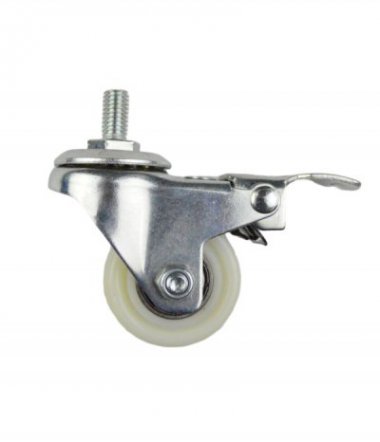
Acceptance: The caster must show no signs of wear or permanent deformation that would impair braking performance .
In the United States, the Institute of Caster and Wheel Manufacturers (ICWM) standards outline similar requirements. The test apparatus must allow the caster to be mounted via its normal attachments and must cycle the braking device through its entire range of motion. This ensures that the physical action of a user engaging the brake is accurately replicated by the machine .
A standard brake fatigue test involves several critical steps to ensure accuracy:
Sample Preparation: A new caster is selected and mounted onto a specialized testing machine.
Load Application: The caster is subjected to its maximum rated load to simulate real-world weight conditions.
Cycling: A mechanical actuator (pneumatic or electric) repeatedly engages and disengages the brake. For instance, a test might run for 5,000 cycles at 10 cycles per minute.
Evaluation: Once the cycles are complete, the caster undergoes a functional check. Technicians look for smooth operation, secure locking, and the absence of cracks or excessive play in the mechanism.
While standards provide the framework, the actual quality of the brake system depends heavily on the manufacturer's engineering and quality control processes. Advanced manufacturers invest in automated testing labs to ensure every batch meets these stringent requirements.
For instance, China FFIBU Casters Co., Ltd. (Zhongshan Feibu Caster Co., Ltd.) is a prominent enterprise that emphasizes rigorous testing. Established in 2002 and located in Zhongshan, China, the company integrates research, production, and testing. They have invested in a professional caster testing laboratory where products undergo various evaluations, including brake fatigue tests, before leaving the factory. By utilizing advanced automated production lines and comprehensive testing protocols, China FFIBU Casters Co., Ltd. ensures that their industrial and medical casters deliver the durability and safety required by global markets .
Caster brake fatigue testing is not just a regulatory formality; it is a fundamental assurance of product safety and longevity. By adhering to standards like EN 12530 and T/ZSJL 001-2019, manufacturers can guarantee that their products will withstand the rigors of daily use. When sourcing casters for critical applications, partnering with manufacturers who prioritize these tests—such as China FFIBU Casters Co., Ltd.—is essential for minimizing risk and ensuring operational excellence.
 中文简体
中文简体  English
  Español
  العربية
  Français
  Русский
  Português
  Deutsch
  日本語
日本語  한국어
한국어  Tiếng Việt
  हिन्दी
  Italiano
  Nederlands
  Türkçe
  Polski
  ไทย
ไทย  Română
  বাংলা
বাংলা  Українська
  עברית
עברית  Lietuvių
  Bahasa Indonesia
  Svenska
  Magyar
  Dansk
Dansk  Suomi
Suomi  Čeština
  Ελληνικά