Select Language
Casters play a vital role in mobility, but controlling that mobility is just as important as achieving it. Choosing between braked and unbraked casters directly affects safety, stability, and operational efficiency. Understanding when to use each type ensures your equipment performs exactly as needed.
A braked caster includes a mechanism to temporarily stop movement. Common brake types include:
Total Lock Brake – Locks both the wheel rotation and swivel motion for complete immobilization.
Wheel Brake – Stops only wheel rotation, allowing swivel movement.
Directional Lock (Swivel Lock) – Locks the swivel head so the caster moves only in a straight line.
Brakes are typically engaged via a pedal, lever, or side-action mechanism integrated into the caster housing.
Safety: Prevent unintended rolling on slopes or uneven floors.
Stability: Keep workstations, scaffolding, or mobile equipment stationary during use.
Precision Handling: Allow operators to lock certain casters for straight-line tracking.
Braked casters are essential in environments such as hospitals, laboratories, food production lines, and heavy manufacturing facilities. Under the FFIBU brand, China Zhongshan FFIBU Casters Co., Ltd offers multiple braking configurations across light, medium, and heavy duty series, engineered for quick engagement and secure holding power.
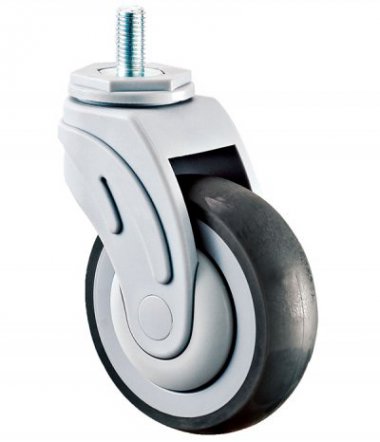
Use braked casters when:
Equipment must remain fixed during operation.
Loads are transported on inclined surfaces.
Precise positioning is required (e.g., medical beds, assembly fixtures).
Safety regulations require locking mechanisms for mobile units.
Examples include hospital beds, mobile workbenches, platform trucks carrying fragile goods, and industrial ladders.
Unbraked casters have no locking mechanism. They are lighter, simpler, and generally less expensive. Their primary advantage lies in unrestricted mobility, making them ideal for applications where constant movement is required and accidental rolling is not a concern.
Use unbraked casters when:
Equipment is frequently moved short distances on flat, level floors.
Operators remain with the equipment at all times.
Weight and cost must be minimized.
No regulatory requirement mandates brakes.
Common uses include office chairs, shopping carts, lightweight display racks, and internal delivery trolleys within controlled environments.
The decision often comes down to risk versus convenience. If there is any possibility of unintended movement causing injury, product damage, or workflow disruption, braked casters are the safer choice. For fast-paced, repetitive movement in safe areas, unbraked casters deliver efficiency and simplicity.
With a comprehensive selection of both braked and unbraked models, FFIBU casters from China Zhongshan FFIBU Casters Co., Ltd allow you to tailor mobility solutions precisely to your operational needs—balancing safety, control, and ease of movement.
 中文简体
中文简体  English
  Español
  العربية
  Français
  Русский
  Português
  Deutsch
  日本語
日本語  한국어
한국어  Tiếng Việt
  हिन्दी
  Italiano
  Nederlands
  Türkçe
  Polski
  ไทย
ไทย  Română
  বাংলা
বাংলা  Українська
  עברית
עברית  Lietuvių
  Bahasa Indonesia
  Svenska
  Magyar
  Dansk
Dansk  Suomi
Suomi  Čeština
  Ελληνικά