Select Language
In a manufacturing plant or distribution center, the caster is the unsung hero of material flow. Whether it's a heavy-duty weldment cart moving steel components or a mobile storage rack shuttling parts to the line, the right industrial caster determines how safely and efficiently your operation runs. Choosing poorly leads to bent forks, flat-spotted wheels, and unnecessary downtime.
The most common mistake is calculating based on static, perfectly distributed weight. In real-world conditions—uneven concrete floors, dock plates, or sudden turns—one or two casters may bear more than their share of the load.
Formula: (Total Loaded Weight ÷ 3) × 1.3~1.5 Safety Factor
(Divide by 3, not 4, to account for uneven floor contact on a 4-caster cart.)
Example: A cart + load = 600 kg → (600 ÷ 3) × 1.33 ≈ 266 kg minimum rating per caster.
Always round up to the nearest available capacity to extend service life.
Wheel Material | Best For | Pros / Cons |
|---|---|---|
Polyurethane (PU) on Steel/Iron Core | General factory floors, painted/ sealed concrete | Non-marking, high load, floor-protective, quieter than steel. The industry default. |
Nylon / Glass-Filled Nylon | Rough concrete, oily or chemical-exposed areas | Very high load capacity, chemical resistant, low rolling resistance. Can be noisy and may mark soft floors. |
Phenolic / Cast Iron | Extreme loads, high-temp ovens, very smooth concrete | Maximum load bearing, heat tolerant. Noisy, zero floor protection, poor shock absorption. |
Industrial Rubber / TPR | Uneven floors with debris, vibration-sensitive loads | Excellent shock absorption, quiet. Lower load capacity than PU or nylon. |
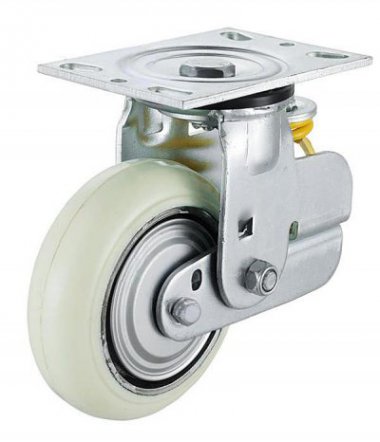
Kingpinless Swivel: For tow-line carts, powered tugs, or continuous heavy use, kingpinless designs eliminate the weak point of a single kingpin bolt and distribute load across a precision-machined raceway—significantly extending life under impact.
Bearings: Precision ball or tapered roller bearings reduce start-up force on heavy carts. Plain bore or Delrin sleeves are acceptable only for lightly loaded, infrequently moved racks.
Configuration: Most 4-wheel carts use 2 rigid (fixed) + 2 swivel for a balance of straight-line tracking and maneuverability. All-swivel with brakes is common for compact work cells.
Mobile racking often has a higher center of gravity than flat carts.
Use larger diameter wheels (125 mm / 5" or above) to overcome thresholds and floor cracks.
Ensure top plate bolt patterns match your rack base—typically 100×80 mm or 115×100 mm for medium/heavy duty.
For racks that must stay put when loaded, specify total-lock brakes on at least two casters.
China Zhongshan FFIBU Casters Co., Ltd manufactures a full spectrum of industrial casters under the FFIBU brand—from medium-duty zinc-plated series for general warehouse carts to heavy-duty kingpinless welded-yoke casters with PU-on-iron wheels for demanding factory transport. Engineered with precision raceways, sealed bearing options, and impact-resistant housings, FFIBU casters are built to withstand the rigors of daily material handling in production and logistics environments.
 中文简体
中文简体  English
  Español
  العربية
  Français
  Русский
  Português
  Deutsch
  日本語
日本語  한국어
한국어  Tiếng Việt
  हिन्दी
  Italiano
  Nederlands
  Türkçe
  Polski
  ไทย
ไทย  Română
  বাংলা
বাংলা  Українська
  עברית
עברית  Lietuvių
  Bahasa Indonesia
  Svenska
  Magyar
  Dansk
Dansk  Suomi
Suomi  Čeština
  Ελληνικά