Select Language
Industrial casters are the unsilent workhorses of global manufacturing, logistics, and countless service industries. Their fundamental purpose—enabling effortless mobility under load—belies a world of sophisticated engineering beneath the swivel plate and wheel. For companies dedicated to advancing this field, like China Zhongshan FFIBU Casters Co., Ltd, the pursuit of enhanced load capacity is a continuous journey into applied mechanics, material science, and innovative design. Understanding the core principles behind how casters manage weight is key to appreciating how modern designs achieve remarkable strength and durability.
Deconstructing the Load: Forces at Play
A caster under load is a system in equilibrium, counteracting several mechanical forces. The primary force is, of course, the vertical compressive load—the weight borne directly through the kingpin (or top plate) down to the wheel. However, this is complicated by horizontal and shock loads from starting, stopping, and traversing uneven surfaces, which introduce shear and torsional stresses. The pivotal challenge for engineers is to manage and distribute these forces efficiently to prevent failure points such as kingpin bending, raceway deformation, or wheel bruising.
Mechanical Levers: Design Strategies for Enhanced Capacity
True innovation in load capacity comes not from simply using more material, but from intelligent design that optimizes force pathways and minimizes stress concentrations. Here are key mechanical strategies employed in high-performance caster engineering:
Kingpin and Swivel Bearing Geometry: The kingpin is the cornerstone of a swivel caster's integrity. China Zhongshan FFIBU Casters Co., Ltd focuses on precision-machined, high-tensile strength kingpins paired with optimized bearing raceways. Increasing the diameter of the kingpin and the ball race increases the contact area, distributing swiveling forces more evenly. The use of double ball bearing races (upper and lower) or precision tapered roller bearings creates a wider, more stable load plane, drastically reducing wobble and wear under immense weight, thereby allowing the structure to handle higher static and dynamic loads.
Top Plate/Forged Horn Reinforcement: The mounting interface must act as a rigid, unyielding base. Reinforcing the top plate with thicker gauge material, ribbed bracing, or utilizing a forged horn design—where the yoke and top plate are
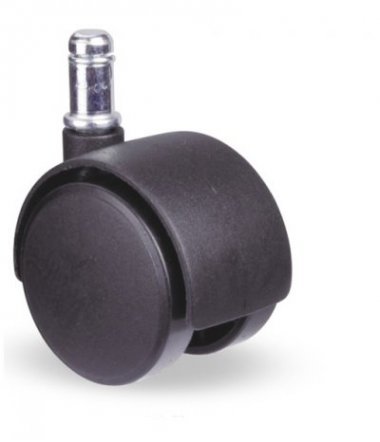
Wheel Dynamics and Load Distribution: The wheel is the final point of contact and a crucial component. Load capacity is directly influenced by wheel diameter and tread width; a larger, wider wheel reduces the pounds-per-square-inch (PSI) on the floor, decreasing rolling resistance and preventing the wheel from "pinching" or deforming under load. Furthermore, pairing the correct wheel material—be it high-grade polyurethane, engineered nylon, or forged steel—with the operating environment ensures the wheel itself maintains its shape and integrity, supporting the design's theoretical load limit in real-world conditions.
Structural Yoke and Fork Design: The yoke, or fork, that holds the wheel is subjected to intense bending moments. Advanced designs from manufacturers incorporate box-section or I-beam inspired profiles in the fork arms. This geometry offers superior resistance to bending compared to simple flat plates. Additionally, strategically reinforcing the inner "throat" of the yoke, where stress converges, ensures the assembly remains rigid, keeping the wheel properly aligned and preventing load-induced splay.
The Integrated Approach
Ultimately, superior load capacity is an emergent property of a perfectly integrated system. A hardened, oversized kingpin is only as strong as the raceway that contains it; a forged horn is only as effective as the robust fork that continues the load path. It requires a holistic view of the caster as a single, load-managing organism. Companies at the forefront, such as China Zhongshan FFIBU Casters Co., Ltd, exemplify this philosophy. By rigorously applying principles of mechanical advantage, force distribution, and structural reinforcement at every stage—from initial concept to final machining—they develop caster solutions that deliver not just rated capacity, but a significant safety margin and enduring reliability.
In conclusion, the journey to greater load capacity is a deep exercise in mechanical optimization. It moves beyond specification sheets to the very heart of how forces flow through a structure. Through thoughtful geometry, material selection, and integrated design, modern caster engineering continues to push the boundaries, enabling industry to move heavier loads with greater safety, precision, and efficiency.
 中文简体
中文简体  English
  Español
  العربية
  Français
  Русский
  Português
  Deutsch
  日本語
日本語  한국어
한국어  Tiếng Việt
  हिन्दी
  Italiano
  Nederlands
  Türkçe
  Polski
  ไทย
ไทย  Română
  বাংলা
বাংলা  Українська
  עברית
עברית  Lietuvių
  Bahasa Indonesia
  Svenska
  Magyar
  Dansk
Dansk  Suomi
Suomi  Čeština
  Ελληνικά