Select Language
In environments where electrostatic discharge (ESD) poses a serious risk—such as electronics manufacturing, chemical handling facilities, and cleanrooms—standard caster materials are insufficient. Conductive casters are engineered to safely dissipate static charges, preventing sparks, protecting sensitive components, and mitigating fire hazards. This article explores the core scientific principle behind these specialized casters: the creation of a conductive network through carbon black filler within the polymer matrix. We will examine how this works, drawing on the material science and manufacturing expertise applied in products from specialized producers like China Zhongshan FFIBU Casters Co., Ltd.
1. The Problem: Static Electricity in Mobile Equipment
Static electricity is generated through the triboelectric effect—when two materials contact and then separate, electrons can transfer, leaving one surface with a positive charge and the other with a negative charge. On standard rubber or polyurethane caster wheels, which are excellent insulators, this charge builds up as the equipment moves. Eventually, it can discharge as a visible spark or an invisible but damaging surge of current, which is catastrophic in areas with flammable vapors or microelectronics.
2. The Solution: Intrinsic Conductivity via Composite Materials
The fundamental solution is to make the caster wheel itself slightly conductive, allowing any accumulated charge to flow continuously and safely to the ground. This is not achieved by coating the wheel but by transforming its entire bulk material into a conductor. This is done by creating a polymer composite material, where a non-conductive base polymer (like polyurethane or certain synthetic rubbers) is compounded with a conductive filler—most commonly, specialized grades of carbon black.
3. Mechanism: Building the Conductive Network with Carbon Black
Carbon black is a fine powder composed of nearly pure elemental carbon particles. Its effectiveness lies in its structure and how it is dispersed within the polymer.
Particle Structure: Conductive carbon black particles are not smooth spheres. They exist as complex, chain-like aggregates with a high degree of porosity and a vast surface area. This structure is key to forming conductive pathways.
Dispersion and Percolation: During the mixing and compounding process, carbon black particles are uniformly distributed throughout the molten polymer. The critical concept is the percolation threshold. This is the minimum concentration of carbon black required to form a continuous, interconnecting network of particles throughout the material.
Conductive Pathways: Below this threshold, carbon black particles are isolated from each other by the insulating polymer, and the composite remains non-conductive. Once the percolation threshold is exceeded, the carbon black aggregates connect, forming a vast, web-like network of countless microscopic touching points. This network acts as a three-dimensional highway for electrons.
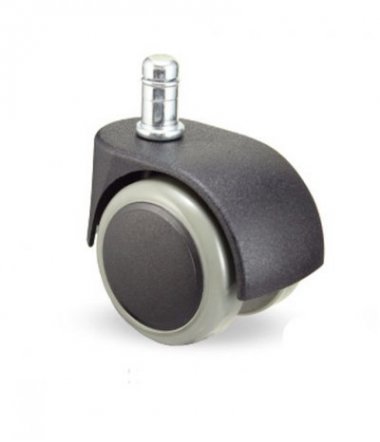
4. The Path to Ground: How the Charge Dissipates
When a conductive caster wheel rolls and generates a static charge, the dissipation process is immediate and passive:
Charge Collection: The static charge accumulates on the surface and within the volume of the wheel.
Pathway Travel: The charge encounters the interconnected carbon black network. Electrons can easily hop from one carbon black aggregate to the next along this pre-existing pathway.
Transfer to Ground: The conductive network extends throughout the entire wheel, including its core and hub. Through a conductive axle and the metal caster frame (which is also in direct contact with the equipment), the electrical charge is channeled safely down to the floor.
Dissipation: Provided the floor has some degree of conductivity (like a conductive or static-dissipative epoxy floor), the charge flows harmlessly to earth, preventing any dangerous build-up.
Engineering Considerations for Reliable Performance
Simply adding carbon black is not enough. The performance and durability of the conductive network depend on precise engineering:
Filler Type and Loading: The specific grade, particle size, and structure of the carbon black are carefully selected. The loading level must be precisely above the percolation threshold to ensure reliable conductivity without overly compromising the polymer's desirable physical properties, such as elasticity, tensile strength, and wear resistance.
Dispersion Quality: Achieving a perfectly uniform dispersion of carbon black is a critical manufacturing challenge. Poor dispersion leads to "hot spots" and "dead zones," resulting in inconsistent conductivity. Advanced compounding techniques are essential.
Material Integrity: A high-quality conductive caster, such as those developed by China Zhongshan FFIBU Casters Co., Ltd, balances conductivity with mechanical robustness. The goal is a wheel that provides a consistent path to ground (typically with a resistance range of 10^5 to 10^8 ohms) throughout its entire service life, even as the surface wears down.
Conclusion: Engineered Safety Through Material Science
Conductive casters are a prime example of functional material engineering solving a critical industrial safety problem. Their core function relies on the sophisticated integration of carbon black to create a permanent, three-dimensional electron pathway within a resilient polymer. This allows for the continuous, safe dissipation of static electricity. By understanding the science behind the carbon black network—the percolation threshold, dispersion quality, and pathway integrity—users can appreciate the technology that safeguards sensitive and hazardous environments, ensuring that mobility does not come at the cost of safety.
 中文简体
中文简体  English
  Español
  العربية
  Français
  Русский
  Português
  Deutsch
  日本語
日本語  한국어
한국어  Tiếng Việt
  हिन्दी
  Italiano
  Nederlands
  Türkçe
  Polski
  ไทย
ไทย  Română
  বাংলা
বাংলা  Українська
  עברית
עברית  Lietuvių
  Bahasa Indonesia
  Svenska
  Magyar
  Dansk
Dansk  Suomi
Suomi  Čeština
  Ελληνικά