Select Language
Uneven wear on caster wheels, especially patterns of edge abrasion or asymmetrical tread erosion, often stems from improper installation alignment rather than product defects. For users seeking to maximize the service life and performance of industrial casters, understanding and correcting mounting angles is essential. This technical discussion explores the principles and practical methods for aligning casters, drawing insights from the engineering standards upheld by manufacturers such as China Zhongshan FFIBU Casters Co., Ltd.
1. The Impact of Misalignment on Caster Performance
When a caster is mounted with its stem or plate not perpendicular to the ground, the wheel contacts the floor at an angle, leading to camber forces. This results in:
Accelerated wear: Load concentrates on a narrow tread band, causing premature abrasion and reducing overall service life.
Increased rolling resistance: Friction increases significantly, requiring greater force to move equipment and elevating energy costs.
Unstable steering: Swivel casters may exhibit erratic or sticky rotation, which can affect maneuverability and safety.
Such issues are especially critical in high-load or high-frequency applications, where consistent performance and durability are paramount. Proper mounting alignment is, therefore, a foundational factor in achieving the designed performance of engineered caster systems.
2. Key Principles for Correct Mounting Alignment
The core objective is to ensure the caster stem or mounting plate is precisely perpendicular to the floor surface when the equipment is in its normal loaded state. This allows the wheel to maintain full tread contact, distributing weight evenly and facilitating smooth movement.
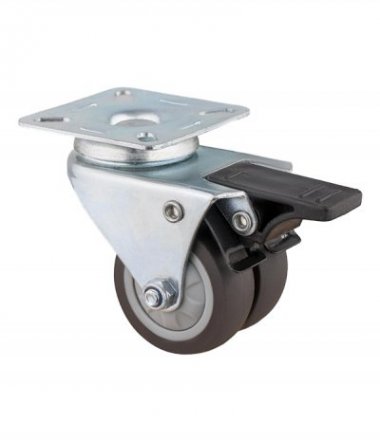
Alignment involves:
Verification during installation: Prior to final fastening, the mounting angle should be checked with a level or square, especially on non-uniform equipment bases.
Use of alignment aids: Shims or adjustable mounting plates can correct minor angular deviations, ensuring stable and even contact.
3. Practical Steps for Assessment and Correction
Step 1: Inspect wear patterns
If a caster shows concentrated abrasion along one edge, it likely indicates angular misalignment. In such cases, visual or tool-based inspection of mounting hardware is recommended.
Step 2: Adjust using appropriate hardware
For bolt-on casters, carefully positioned washers or shims can be added between the equipment base and mounting plate to bring the stem to a perpendicular position. Threaded stem casters may require adjustment of the mounting sleeve angle or the use of angled adapter plates.
Step 3: Post-adjustment testing
After realignment, the equipment should be rolled and observed for smooth operation. Even tread contact and effortless swiveling are key indicators of correct installation.
4. Maintenance Considerations for Long-Term Performance
Even with ideal initial alignment, factors such as equipment load shifts, floor unevenness, or long-term structural deflection can affect caster orientation. Periodic inspection of mounting hardware and wear patterns is recommended, especially in demanding operational environments. Manufacturers like China Zhongshan FFIBU Casters Co., Ltd emphasize the importance of routine checks to sustain performance.
5. Conclusion: Engineering Durability through Precision Alignment
Proper mounting alignment is not merely an installation detail—it is a core engineering practice that directly influences equipment safety, efficiency, and operational cost. By ensuring the mounting angle allows the wheel to maintain full and even ground contact, users can prevent premature wear, enhance mobility, and extend the functional lifespan of caster systems. This practice reflects the holistic approach to quality and durability embedded in products from China Zhongshan FFIBU Casters Co., Ltd, reinforcing the value of precise installation and informed maintenance.
 中文简体
中文简体  English
  Español
  العربية
  Français
  Русский
  Português
  Deutsch
  日本語
日本語  한국어
한국어  Tiếng Việt
  हिन्दी
  Italiano
  Nederlands
  Türkçe
  Polski
  ไทย
ไทย  Română
  বাংলা
বাংলা  Українська
  עברית
עברית  Lietuvių
  Bahasa Indonesia
  Svenska
  Magyar
  Dansk
Dansk  Suomi
Suomi  Čeština
  Ελληνικά