Select Language
Selecting the right caster wheel material is a critical decision that impacts equipment longevity, operational noise, and workplace safety. Polyurethane (PU) and rubber are two of the most popular choices, yet they perform very differently under real-world conditions. This article provides a technical, data-informed comparison focusing on three core performance metrics: wear resistance, noise level, and traction.
1. Wear Resistance: PU’s Dominant Arena
In terms of pure abrasion resistance and service life, polyurethane holds a decisive advantage.
PU Casters (High Durability): Polyurethane is an engineered polymer known for its exceptional toughness. In standardized abrasion tests (e.g., DIN 53516), PU typically exhibits 3 to 5 times greater wear resistance compared to standard rubber. This translates directly to a longer operational lifespan, especially on rough concrete floors or in high-cycle logistics applications. PU wheels are less prone to cutting, chunking, and developing flat spots under heavy static loads.
Rubber Casters (Moderate Durability): While certain synthetic rubbers offer good performance, standard rubber compounds wear down more quickly under abrasive conditions. They are more susceptible to damage from sharp debris and can suffer from "flat-spotting" if equipment is left stationary for extended periods.
Verdict: For high-mileage, heavy-load, or rough-surface applications, PU is the clear winner for minimizing replacement frequency and downtime.
2. Noise & Vibration: Rubber’s Acoustic Edge
When a quiet, smooth ride is the priority—such as in hospitals, libraries, or offices—material elasticity becomes paramount.
Rubber Casters (Superior Dampening): Rubber’s natural viscoelasticity makes it an excellent shock absorber. It effectively dampens vibrations from floor joints, cracks, and minor imperfections. This results in significantly quieter operation, often measuring 3-5 decibels lower than equivalent PU wheels. This "silent roll" is crucial for patient comfort and noise-sensitive environments.
PU Casters (Firm & Quiet): While much quieter than hard plastics or nylon, PU is a denser, less elastic material. It transmits more high-frequency vibration and can produce a more audible "rumble" over uneven surfaces, though high-quality formulations from manufacturers like China Zhongshan FFIBU Casters Co., Ltd are engineered for low-noise performance.
Verdict: For the absolute quietest operation and best vibration isolation, rubber holds the advantage.
3. Traction & Grip: The Safety Trade-Off
Traction involves a complex balance between material coefficient of friction and floor contact.
Rubber Casters (High Traction): Rubber offers a higher coefficient of friction on most surfaces, particularly on wet floors, ramps, or slick tiles. This superior grip enhances control and reduces the risk of uncontrolled sliding, making it a safer choice for坡道 (ramps) and potentially hazardous environments.
PU Casters (Controlled Roll): PU provides adequate traction on dry, smooth surfaces but can be more prone to slipping on wet or oily floors. Its advantage lies in lower rolling resistance, which makes heavy equipment easier to push over long distances, albeit with a slightly reduced "grip" factor compared to rubber.
Verdict: For maximum anti-slip safety and坡道 (ramp) stability, rubber provides better traction.
4. Floor Protection & Chemical Resistance
Floor Protection: Both materials can be formulated to be non-marking. However, high-quality PU is often preferred for sensitive floors (e.g., epoxy, hardwood) as it is inherently less likely to leave stains or scuff marks. Cheaper black rubber wheels can sometimes leave dark marks on light-colored floors.
Chemical Resistance: PU demonstrates excellent resistance to oils, greases, and many industrial chemicals, whereas natural rubber can swell or degrade upon contact with hydrocarbons.
Decision Matrix: How to Choose
Scenario | Recommended Material | Rationale |
|---|---|---|
Warehouse, Factory, Logistics | PU Caster | Superior wear resistance handles heavy loads and abrasive floors, reducing long-term costs. |
Hospital, Library, Office | Rubber Caster | Excellent noise reduction and vibration dampening protect patients and ensure quiet operation. |
Outdoor,坡道 (Ramps), Wet Floors | Rubber Caster | Higher friction coefficient provides essential grip and safety on slippery surfaces. |
Cleanrooms, Sensitive Floors | PU Caster | Non-marking properties and resistance to cleaning chemicals protect floor finishes. |
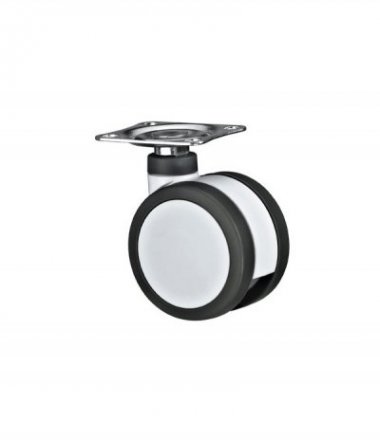
Conclusion
There is no universal "best" material—only the best material for your specific application. Choose PU for durability, load capacity, and clean operation on smooth floors. Choose rubber for silence, shock absorption, and superior traction on challenging surfaces. By understanding these performance trade-offs, you can select the caster that optimizes both equipment performance and operational safety.
 中文简体
中文简体  English
  Español
  العربية
  Français
  Русский
  Português
  Deutsch
  日本語
日本語  한국어
한국어  Tiếng Việt
  हिन्दी
  Italiano
  Nederlands
  Türkçe
  Polski
  ไทย
ไทย  Română
  বাংলা
বাংলা  Українська
  עברית
עברית  Lietuvių
  Bahasa Indonesia
  Svenska
  Magyar
  Dansk
Dansk  Suomi
Suomi  Čeština
  Ελληνικά