Select Language
In the modern workshop—whether a professional fabrication bay, an automotive garage, or a home woodworking studio—the toolbox is more than storage. It is a mobile command center. Few things disrupt productivity more than a toolbox that is difficult to move, tips under load, or damages the floor every time it rolls. Yet the component responsible for solving all these problems—the caster—is often selected as an afterthought.
Choosing the right casters for workshop toolboxes is a precise exercise in mechanical engineering, material science, and ergonomic planning. It requires understanding load distribution, vibration control, floor conditions, and daily usage patterns. China Zhongshan FFIBU Casters Co., Ltd, through its FFIBU brand, has built a global reputation by engineering mobility solutions specifically for demanding industrial and maker environments. This guide explores how to choose casters that turn a stationary toolbox into a reliable, mobile workstation.
Unlike retail carts or kitchen equipment, workshop toolboxes present a set of mechanical challenges that few other applications share:
Extreme Point Loads: A fully loaded 72-inch roller cabinet can exceed 1,000 pounds, with most of that weight concentrated in a small footprint.
Uneven Surfaces: Workshop floors are rarely pristine. Concrete cracks, expansion joints, and debris create constant impact forces.
Frequent Starts and Stops: Technicians move toolboxes several times a day, generating high torque loads on caster forks and wheels.
Chemical Exposure: Oil, cutting fluid, brake cleaner, and solvents regularly come into contact with wheels and housings.
Standard light-duty casters simply cannot survive these conditions. FFIBU approaches toolbox mobility with industrial-grade engineering, designing every component to handle both static weight and dynamic stress.
The single most important decision in caster selection is wheel material. For workshops, FFIBU offers four primary compounds, each optimized for specific floor types and environmental conditions:
Wheel Material | Best For | Key Advantages |
|---|---|---|
High-Density Polyurethane (HDPU) | Epoxy-coated concrete, painted floors, smooth shop floors | Non-marking, chemical-resistant, absorbs vibration, protects floor finishes |
Forged Steel | Rough concrete, outdoor yards, metal fabrication shops | Maximum durability, extreme load capacity, withstands metal shavings and debris |
Phenolic Resin | Dry environments, wood shops, assembly areas | Heat-resistant, spark-resistant, economical for heavy loads |
Elastomer-Rubber Hybrid | Mixed-use floors, technician carts | Superior grip, quiet operation, shock absorption |
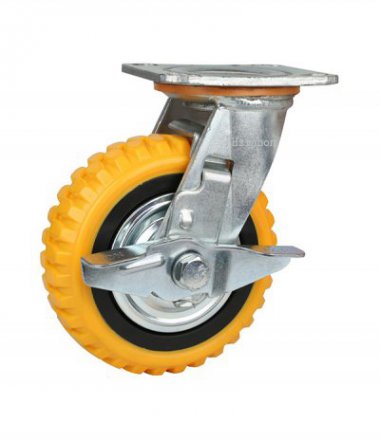
FFIBU’s HDPU formulation deserves special mention. Unlike generic polyurethanes that flatten under heavy loads, FFIBU’s HDPU retains its shape even after prolonged compression. This prevents the “flat spot” problem that causes toolboxes to vibrate excessively when rolled after sitting overnight.
Underestimating load requirements is the number one cause of caster failure. FFIBU engineers recommend a calculation method tailored for toolboxes:
Minimum Per-Caster Capacity = (Total Loaded Weight × 2.0) ÷ Number of Casters
The 2.0 multiplier accounts for dynamic forces—starting inertia, stopping momentum, and impact from rolling over obstacles. For example, a 900-pound toolbox with four casters requires casters rated for at least 450 pounds each. FFIBU’s Heavy-Duty Series casters exceed these ratings with reinforced forged steel yokes and oversized axles.
Workshops are crowded environments. A toolbox must navigate narrow aisles, fit under workbenches, and position precisely next to machinery. Swivel caster performance is critical.
FFIBU incorporates two technologies to improve maneuverability:
Precision Ball-Bearing Swivels: Double-row ball races reduce steering effort by up to 40% compared to standard swivel heads.
Directional Lock Mechanisms: Optional swivel locks allow the caster to function like a rigid wheel when moving long distances, improving tracking and reducing operator fatigue.
For large roller cabinets, FFIBU recommends a two-rigid, two-swivel configuration. This balances maneuverability with straight-line stability—especially important when moving heavy toolboxes across large bays.
Many workshops install epoxy-coated or sealed concrete floors to reduce dust. These surfaces are easily damaged by hard wheels. However, softer wheels often sacrifice load capacity.
FFIBU solves this with a layered wheel design: a high-durometer polyurethane tread bonded to a reinforced core. The tread protects the floor, while the core supports extreme loads. For technicians working in customer-facing facilities—such as automotive dealerships—this prevents costly floor damage claims.
Workshop chemicals attack caster components in multiple ways: solvents degrade rubber, oil penetrates bearings, and metal shavings embed in wheel treads. FFIBU addresses these threats through:
Sealed Precision Bearings: Prevents contamination from grinding dust and metal filings.
Corrosion-Resistant Housings: Zinc-plated or stainless steel options resist rust from coolant and cutting fluid exposure.
Non-Porous Wheel Compounds: Prevent chemical absorption that leads to swelling or degradation.
Maintenance is simplified by FFIBU’s modular design. Bearings, axles, and wheels can be replaced individually without discarding the entire caster—reducing long-term ownership costs.
A transmission specialist uses a 1,200-pound toolbox that must roll across an oil-covered concrete floor. Standard casters failed within six months due to bearing seizure. FFIBU equipped the box with HDPU wheels and sealed stainless bearings. Three years later, the casters remain fully functional with zero maintenance.
A carbon-fiber fabrication workshop required non-sparking casters for flammable resin storage. FFIBU supplied phenolic resin wheels with bronze bushings, eliminating ignition risks while supporting 800-pound loads.
A furniture maker needed quiet, floor-safe mobility for a mobile tool chest in a finished basement workshop. FFIBU’s elastomer hybrid wheels provided smooth, silent operation on engineered hardwood floors without scuffing.
Rolling a heavy toolbox should not require brute force. Poor caster design increases push/pull forces, contributing to back strain and shoulder injuries. FFIBU optimizes ergonomics through:
Low Rolling Resistance Compounds: Reduces initial push force by up to 30%.
Optimized Swivel Offset Geometry: Improves turning efficiency in tight spaces.
Vibration Damping: Minimizes shock transmission to the user’s hands and arms.
These improvements may seem minor, but over thousands of movements per year, they significantly reduce cumulative physical stress on technicians.
A rolling toolbox is also a theft target and a tip hazard. FFIBU integrates security-focused features including:
Foot-Operated Brakes: Locks both wheel rotation and swivel with a single press—no bending required.
Anti-Theft Mounting Kits: Tamper-resistant bolts prevent unauthorized removal.
Wide-Wheelbase Configurations: Lowers the center of gravity, reducing tip risk on uneven surfaces.
In the modern workshop, mobility equals efficiency. A toolbox that moves easily becomes an extension of the technician’s workflow, reducing wasted steps, minimizing setup time, and keeping essential tools exactly where they are needed.
China Zhongshan FFIBU Casters Co., Ltd has spent years refining the FFIBU brand to meet the exacting standards of professional users. Every caster is tested under simulated workshop conditions—extreme loads, chemical exposure, temperature swings, and continuous cycling—to ensure it performs reliably in real-world environments.
When specifying casters for workshop toolboxes, the choice is not about price alone. It is about engineering confidence. With FFIBU, that confidence rolls on every shift, every project, and every mile of workshop floor.
 中文简体
中文简体  English
  Español
  العربية
  Français
  Русский
  Português
  Deutsch
  日本語
日本語  한국어
한국어  Tiếng Việt
  हिन्दी
  Italiano
  Nederlands
  Türkçe
  Polski
  ไทย
ไทย  Română
  বাংলা
বাংলা  Українська
  עברית
עברית  Lietuvių
  Bahasa Indonesia
  Svenska
  Magyar
  Dansk
Dansk  Suomi
Suomi  Čeština
  Ελληνικά