Select Language
In the tightly choreographed ecosystem of an automotive assembly line, precision is everything. A single deviation—a delayed parts delivery, a misaligned chassis fixture, or a stalled carrier—can halt production across an entire facility. While much attention is paid to robotic arms, conveyor belts, and torque systems, there is another class of components operating quietly at floor level that keep the line moving: casters.
From body-in-white framing bucks to sequenced parts trolleys, from battery module carriers to final trim line workstations, casters form the literal foundation of mobile assembly logistics. In this environment, they are subjected to relentless cycles, extreme weights, strict ergonomic requirements, and zero tolerance for failure.
This article delivers a comprehensive technical overview of caster selection for automotive assembly lines, incorporating engineering insight from China Zhongshan FFIBU Casters Co., Ltd, whose FFIBU brand heavy-duty casters are deployed across global vehicle manufacturing plants and Tier‑1 supplier facilities.
Automotive assembly presents a unique combination of stresses that render conventional industrial casters inadequate:
Extreme Dynamic Loads: A fully kitted vehicle body carrier can weigh 1,500–3,000 kg, with additional inertial forces generated during starts, stops, and direction changes.
Continuous Cycling: Casters may roll dozens of kilometers per day, seven days a week, for years without major downtime.
Tight Tolerances: Line-side equipment must track accurately along guide rails, floor tape, or AGV-adjacent pathways without drifting.
Ergonomic Standards: Manual push/pull forces must comply with corporate safety thresholds (often < 150 N starting force).
Chemical Exposure: Brake fluid, coolant, oil, welding spatter, and cleaning agents constantly contact wheels and housings.
ESD Requirements: Electrostatic discharge control is mandatory in electronics and battery assembly zones.
Standard warehouse or retail casters cannot survive this regimen. FFIBU addresses these challenges with purpose-engineered automotive-grade mobility systems.
A common miscalculation is dividing total load equally among four casters. On an automotive line, this assumption is dangerous. Due to floor unevenness, frame flex, and shifting payloads, one or more casters may momentarily carry little to no load, transferring nearly the entire weight to the remaining casters.
FFIBU applies the Three-Caster Rule for assembly line equipment:
Required Caster Capacity = (Static Weight + Dynamic Surge) ÷ 3 × Safety Factor
Recommended safety factors:
1.3× for smooth, flat floors and low-speed movement
1.5–2.0× for high-speed lines, uneven floors, or shock loading
Example:
A chassis framing buck weighs 1,200 kg empty and supports a 1,800 kg body-in-white during assembly (total = 3,000 kg).
Base load per caster: 3,000 ÷ 3 = 1,000 kg
With 1.5× safety factor: 1,500 kg minimum per caster
FFIBU’s heavy-duty kingpinless series routinely meets and exceeds these capacities, with models rated up to 2,500 kg per caster.
Wheel selection is one of the most consequential decisions in automotive caster specification. FFIBU offers multiple compounds tailored to specific line environments:
Wheel Type | Typical Application | Key Properties |
|---|---|---|
High-Density Polyurethane (HD‑PU) | Final assembly, trim lines, general parts carriers | Non-marking, floor-protective, shock absorbing, high wear resistance |
Electrostatic-Conductive PU (ESD‑PU) | Battery pack lines, ECU assembly, electronics zones | Surface resistivity 10⁴–10⁶ Ω, prevents static discharge |
Forged Steel / Cast Iron | Body shop skids, weld fixtures, heavy framing bucks | Extreme load capacity, impact resistant, withstands welding slag |
Nylon / Reinforced Polymer | Powertrain lines, engine dress carts | Low rolling resistance, chemical resistance, lightweight |
Phenolic Resin | Paint shops, drying ovens | Heat-resistant, spark-proof, chemically inert |
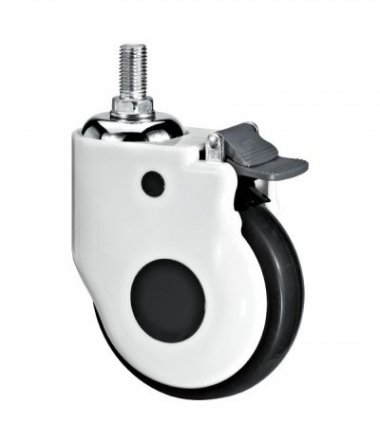
For mixed-use lines, FFIBU often specifies HD‑PU wheels with sealed precision bearings—offering the best compromise between load capacity, floor protection, and ergonomics.
Traditional kingpin casters rely on a central bolt to retain the swivel head. Under automotive loads and side thrust, kingpins loosen, bend, or fracture—resulting in catastrophic caster failure.
FFIBU’s kingpinless design replaces the central bolt with a hardened ball-bearing raceway machined directly into the one-piece stamped or forged steel yoke. Benefits include:
Elimination of kingpin shear risk
Superior distribution of radial and thrust loads
Smoother swiveling under heavy loads
Extended service life under continuous cycling
For chassis and body shop applications, kingpinless construction is considered mandatory by many OEM engineering teams.
Assembly lines often require equipment to follow fixed paths. FFIBU provides several guidance-compatible caster solutions:
V-Groove Wheels: Track along inverted angle iron rails for perfectly straight travel.
Guide Roller Add-ons: Side-mounted rollers prevent lateral drift when following floor tape or magnetic strips.
Directional Lock Kits: Convert swivel casters to rigid mode for long straight-line pushes, then unlock for tight-radius turns at line ends.
These features ensure that heavy carriers stay precisely aligned with conveyors, lifts, and docking stations.
Uncontrolled rolling on an active line is a serious hazard. FFIBU offers braking systems engineered for automotive use:
Dual-Action Total Locks: Single-pedal engagement locks both wheel rotation and swivel action—essential for staged assembly positions.
Foot-Operated Central Brakes: Allows operators to lock all four casters simultaneously without stooping.
Dead-Man Brakes: Spring-engaged, air-release brakes that automatically lock if air pressure is lost—used on powered line-side carts.
All brake pedals are designed for gloved operation and positioned to avoid trip hazards.
Automotive OEMs enforce strict ergonomic limits to prevent musculoskeletal injuries. Excessive push force is a leading cause of non-compliance.
FFIBU optimizes ergonomics through:
Large Diameter Wheels: An 8″ wheel reduces starting force by ~35% compared to a 5″ wheel under identical load.
Precision Ball Bearings: Reduces rolling friction at the axle.
Optimized Swivel Offset: Improves turning efficiency and reduces scrub torque.
Low Durometer Treads: Softer compounds reduce vibration and improve grip without sacrificing load capacity.
Push force simulations are available upon request to validate compliance with corporate ergonomic standards.
Automotive plants expose casters to some of the harshest industrial chemicals:
Solvents and Degreasers: Attack rubber and degrade adhesives.
Welding Slag and Sparks: Melt or pit standard wheels.
Coolant and Oil Mist: Penetrate unsealed bearings.
Battery Acid (EV Lines): Corrodes untreated metals.
FFIBU counters these threats with sealed stainless or zinc-plated housings, chemical-resistant polyurethane formulations, and optional high-temperature wheel compounds for paint and curing ovens.
A Tier‑1 supplier uses a 2,800 kg framing buck to locate doors and panels during welding. Previous casters failed within six months due to kingpin shear.
FFIBU Solution: Eight 6″ kingpinless casters with forged steel wheels, rated 1,500 kg each, total-lock brakes. Service life extended to 36+ months with zero structural failures.
An electric vehicle plant requires ESD-safe mobility for 600 kg battery packs.
FFIBU Solution: 5″ HD‑PU ESD wheels with conductive carbon black additive, stainless steel yokes, and sealed bearings. Surface resistivity maintained within OEM specs after 24‑month durability test.
A carmaker needs silent, non-marking carts for interior trim delivery on polished epoxy floors.
FFIBU Solution: 4″ HD‑PU wheels, kingpinless swivel heads, dual-action brakes. Noise reduced to < 45 dB during movement, with zero floor marking after 18 months.
Automotive lines cannot afford unplanned downtime. FFIBU designs for maintainability:
Modular Construction: Wheels, bearings, and swivel heads can be serviced individually.
Grease Nipples: Allow field lubrication without disassembly.
Visual Wear Indicators: Show wheel tread wear before performance degrades.
Spare Parts Availability: Guaranteed long-term supply for multi-year production programs.
Lifecycle cost analysis consistently favors FFIBU heavy-duty casters over lower-cost alternatives that require frequent replacement.
In automotive assembly, mobility is not optional—it is integral to throughput, quality, and safety. Casters that are underspecified, poorly maintained, or incorrectly selected become bottlenecks that ripple across the entire production schedule.
China Zhongshan FFIBU Casters Co., Ltd brings decades of focused engineering to this challenge. Every FFIBU caster is designed around the realities of automotive manufacturing: extreme loads, continuous cycling, chemical exposure, and zero-defect expectations. Whether supporting a 3‑ton chassis buck or guiding a sensitive battery carrier, FFIBU delivers mobility solutions that keep the line moving—shift after shift, vehicle after vehicle.
When mobility matters as much as horsepower, trust the brand engineered for the world’s most demanding assembly lines.
 中文简体
中文简体  English
  Español
  العربية
  Français
  Русский
  Português
  Deutsch
  日本語
日本語  한국어
한국어  Tiếng Việt
  हिन्दी
  Italiano
  Nederlands
  Türkçe
  Polski
  ไทย
ไทย  Română
  বাংলা
বাংলা  Українська
  עברית
עברית  Lietuvių
  Bahasa Indonesia
  Svenska
  Magyar
  Dansk
Dansk  Suomi
Suomi  Čeština
  Ελληνικά