Select Language
In the modern distribution center, third-party logistics (3PL) facility, and industrial warehouse, space is money. Static pallet racking has long been the backbone of storage, but an increasing number of operations are adopting mobile racking systems—also called mobile shelving, rolling cantilever racks, or portable picking towers—to bring inventory directly to pack stations, staging areas, or loading docks. The component that makes this possible, and the one that most directly determines whether a heavily loaded rack rolls safely or becomes a catastrophic failure point, is the caster.
Selecting casters for warehouse racking systems is fundamentally different from selecting them for carts, dollies, or workbenches. A mobile rack is tall, top-heavy, and carries enormous distributed weight that shifts with every picked pallet. It must traverse expansion joints in concrete floors, endure the impact of dock plates, and remain locked firmly in place when not in motion. This article provides a deep, engineer-level guide to specifying the optimal casters for warehouse racking, with insights from China Zhongshan FFIBU Casters Co., Ltd—whose FFIBU brand heavy-duty industrial casters are purpose-built for high-load material handling applications worldwide.
A typical selective pallet rack bay is stationary because it is anchored to the floor. When you add mobility, you introduce new physical stresses:
High Center of Gravity: Racking commonly reaches 12–20 feet in height. Even modest lateral force from a misstep while pushing can induce tipping if casters lack a wide stance or if the rack is improperly loaded.
Uneven Load Distribution: As pickers remove inventory from one level or side, the center of gravity shifts. On a four-caster system, this can momentarily place nearly the full load on just two or three wheels.
Shock Loading: Rolling a 2,000 kg mobile rack over a ½-inch floor expansion joint generates impact forces that can briefly double the static load on each caster.
Floor Contamination: Warehouse floors are rarely clean—they contain grit, metal shavings, stretch wrap debris, and oil, all of which can jam unsealed bearings.
Light- or medium-duty casters with pressed-steel yokes, thin kingpins, or soft rubber wheels disintegrate under these conditions. FFIBU addresses these demands exclusively with heavy-duty and super-heavy-duty caster architectures: double-ball-bearing swivel raceways, precision-forged or thick-plate stamped steel yokes, and high-durometer polyurethane or nylon wheels engineered for sustained compressive loads.
The single most common cause of caster failure on mobile racking is under-specification. The correct calculation must account not only for the total static weight but also for dynamic load factors and uneven floor conditions.
FFIBU engineers recommend the industry-standard three-caster safety rule for warehouse racking:
Minimum Per-Caster Capacity = (Rack Dead Weight + Maximum Stored Load) ÷ 3 × Safety Factor
The divisor of 3—rather than 4—assumes that on imperfect floors one caster may carry minimal load, leaving the other three to bear the full weight. The safety factor should be:
1.25–1.4× for smooth, level floors with infrequent movement
1.5–2.0× for rough concrete, frequent movement, or shock-load environments
Example: A mobile rack weighs 180 kg empty and holds a maximum of 1,620 kg of inventory. Total = 1,800 kg.
Base per-caster load: 1,800 ÷ 3 = 600 kg
With 1.5× safety factor: 600 × 1.5 = 900 kg minimum rated capacity per caster
FFIBU's Heavy-Duty Series offers individual caster ratings from 300 kg up to 2,000 kg+, ensuring ample margin for such applications. Always specify the next highest available rating above your calculated requirement.
Wheel selection for racking is a trade-off between load capacity, floor protection, rolling resistance, and debris tolerance. FFIBU produces four primary wheel types suited to warehouse racking:
Wheel Material | Load Suitability | Floor Type | Key Characteristics |
|---|---|---|---|
High-Density Polyurethane (PU) | Medium–Very Heavy (300–2,000 kg/caster) | Sealed concrete, epoxy, painted | Non-marking, shock absorbing, protects floors, excellent wear life |
Nylon / Reinforced Polymer | Heavy–Extra Heavy | Smooth concrete, dry environments | Lowest rolling resistance, highest load density, but harder ride and can be noisy |
Phenolic Resin | Heavy | Dry, clean floors | Spark-resistant, heat-tolerant, economical, but brittle if impacted by steel debris |
Forged / Cast Steel | Extra Heavy–Ultra Heavy | Rough concrete, outdoor yards | Maximum impact resistance, extreme loads, but will mark and damage finished floors |
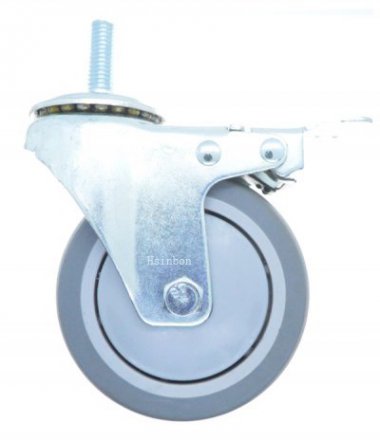
For most indoor distribution centers with sealed concrete, FFIBU's high-performance polyurethane-on-steel-core wheel is the optimal choice. It protects the floor finish, rolls smoothly under heavy loads, and its bonded tread resists delamination even after prolonged static compression—avoiding the "flat spot" problem that plagues inferior urethane wheels.
Warehouse racking casters endure substantial side thrust when the rack is pushed diagonally or turned in place. Traditional kingpin swivel casters—where a single central bolt holds the swivel head together—are vulnerable to kingpin shear under such side loads.
FFIBU's kingpinless heavy-duty casters eliminate the central kingpin entirely. A precision-machined hardened ball bearing raceway is integrated directly into the one-piece forged or stamped steel top plate and yoke base. Advantages include:
Elimination of the #1 failure mode (kingpin loosening / shearing)
Superior distribution of radial and thrust loads
Smoother swiveling under heavy weight
Extended service life in shock-load conditions
For mobile racking exceeding 1,000 kg total moving weight, kingpinless construction is strongly advised.
Maneuverability requirements dictate the swivel-to-rigid ratio:
Two Swivel + Two Rigid (Front/Rear): The industry standard for rectangular mobile rack bases. Provides adequate turning in aisles while maintaining straight-line tracking. Best for most warehouse racking.
Four Swivel: Used when racking must pivot in place within very tight confines or be rotated for access from multiple sides. Increases push force slightly and reduces directional stability.
Directional Lock Kits: Optional swivel locks convert a swivel caster to rigid mode, allowing a rack to be steered straight down a long aisle then unlocked for tight-quarter positioning—FFIBU offers this as an accessory on its HD series.
A mobile rack that drifts while employees are picking from upper levels is a serious safety hazard. Effective locking is non-negotiable.
FFIBU supplies three brake configurations for racking casters:
Wheel Brake (Side Tread Press): Locks wheel rotation only; swivel remains free. Adequate for short-term immobilization on level floors.
Swivel Lock (Top Lock): Locks swivel mechanism only; wheel rolls freely. Useful for converting to straight-line travel.
Total Lock / Dual-Action Brake: Simultaneously locks both wheel rotation and swivel 360° action with a single foot pedal. This is the recommended specification for mobile racking—it prevents both rolling and pivoting on uneven or slightly sloped warehouse floors.
Pedals are positioned for foot engagement without the operator needing to stoop—an ergonomic consideration FFIBU builds into its heavy-duty caster design.
Mobile racking typically uses top-plate mounted casters bolted to structural channel or angle iron welded to the rack base. Critical checks include:
Plate Dimensions: Heavy-duty racking casters commonly use 100×80 mm, 115×100 mm, or 135×105 mm (4″×4.5″ / 4.5″×6.25″ imperial equivalent) top plates. Verify bolt hole spacing matches your rack base.
Bolt Grade: Use high-tensile Grade 8.8 (or equivalent) hex bolts with lock nuts. Lag screws into thin upright metal are unacceptable.
Overall Height & Offset: Ensure the caster's installed height does not raise the rack's center of gravity beyond safe limits and that wheel offset clears adjacent uprights or cross-bracing.
FFIBU provides detailed CAD dimensional drawings and can supply custom bolt kits matched to base thickness upon request.
A picking tower (rack + wire shelving) holds 800 kg of picked goods. Total moving mass = 980 kg. Using the 3-caster rule with 1.5× SF → 490 kg/caster required.
FFIBU Solution: 6-inch (150 mm) kingpinless heavy-duty casters with 95A polyurethane tread on steel core, rated 600 kg each, dual-action total-lock brakes. Installed on 4-point (2 swivel / 2 rigid) configuration. Result: smooth manual push with one operator, zero caster replacements after 3 years of daily use.
A steel service center needs to move 1,500 kg of long stock on a dual-bay cantilever rack over rough, oil-splashed concrete.
FFIBU Solution: 8-inch nylon-tread wheels on kingpinless forged-yoke casters, rated 800 kg each, with sealed precision roller bearings to resist contamination from metal shavings. Zinc-plated housing for corrosion resistance against cutting oil mist.
Ambient-temperature racking converted for use in a +2°C / -18°C frozen food warehouse. Standard PU becomes brittle.
FFIBU Solution: Cold-formula polyurethane compound retaining elasticity below -30°C, mounted on 304 stainless steel yokes to resist condensation-induced corrosion in wash-down areas.
A common oversight is specifying casters strong enough to holdthe load but not easy enough to moveit. Larger diameter wheels reduce starting resistance significantly—an 8-inch wheel requires roughly 30–40% less initial push force than a 5-inch wheel under the same load. FFIBU's precision ball or roller bearing wheel axles further minimize friction. For racks expected to be moved by a single operator, wheel diameter should be the maximum practical given the rack's base clearance, and polyurethane tread hardness should be selected to balance roll ease against load capacity.
Mobile racking systems unlock flexibility in warehouse design—condensing pick paths, enabling reconfigurable storage zones, and bringing product closer to pack stations. But that flexibility is only as reliable as the casters beneath it. Under-specifying invites bent forks, seized swivels, floor damage, and unsafe conditions. Over-specifying with industrial-grade components from China Zhongshan FFIBU Casters Co., Ltd ensures that a fully loaded rack rolls smoothly, locks securely, and endures for years in punishing warehouse environments.
The FFIBU brand stands for application-driven engineering: casters are not pulled from a generic catalog and hoped to work—they are selected against calculated loads, floor conditions, and operational realities. When mobility matters as much as storage capacity, that distinction is what keeps your warehouse moving.
 中文简体
中文简体  English
  Español
  العربية
  Français
  Русский
  Português
  Deutsch
  日本語
日本語  한국어
한국어  Tiếng Việt
  हिन्दी
  Italiano
  Nederlands
  Türkçe
  Polski
  ไทย
ไทย  Română
  বাংলা
বাংলা  Українська
  עברית
עברית  Lietuvių
  Bahasa Indonesia
  Svenska
  Magyar
  Dansk
Dansk  Suomi
Suomi  Čeština
  Ελληνικά