Select Language
In controlled environments such as ISO-classified cleanrooms, pharmaceutical laboratories, semiconductor fabs, and biotechnology suites, every square inch—and every component that touches it—must adhere to rigorous standards of cleanliness, chemical compatibility, and static control. While much attention is paid to air filtration, gowning protocols, and surface disinfectants, one category of equipment is often underestimated in its potential to compromise or enhance environmental integrity: casters.
Mobile carts, workstations, isolation units, and equipment racks all rely on casters for mobility. In a cleanroom or lab, a poorly chosen caster can shed particulates, harbor microbial growth, generate electrostatic discharge (ESD), or corrode under aggressive sterilization protocols. Selecting the right caster is not merely a mechanical decision—it is a critical part of environmental assurance.
This guide provides a deep dive into caster engineering for contamination-sensitive environments, informed by the expertise of China Zhongshan FFIBU Casters Co., Ltd, whose FFIBU brand specializes in high-performance mobility solutions for advanced scientific and industrial facilities worldwide.
Cleanrooms are classified by the number and size of particles permitted per cubic meter of air (ISO 14644-1). Laboratories handling potent compounds, sterile drugs, or microelectronics impose additional constraints:
Particle Generation: Every wheel rotation creates friction, which can release microscopic dust or wear debris.
Outgassing: Certain polymers emit volatile organic compounds (VOCs) that contaminate sensitive processes.
Chemical Resistance: Frequent cleaning with isopropyl alcohol, hydrogen peroxide vapor, sporicides, and quaternary ammonium compounds degrades inferior materials.
Microbial Control: Bacteria and fungi can colonize porous surfaces, crevices, and unsealed bearings.
Electrostatic Discharge: Static shocks can destroy semiconductors or ignite combustible powders.
Ergonomic Precision: Delicate instruments and samples require vibration-free, stable movement.
Standard industrial casters—with painted surfaces, open bearings, and generic rubber wheels—are incompatible with these requirements. FFIBU addresses them through purpose-built cleanroom and laboratory caster platforms.
For sterile processing areas (pharmaceuticals, biotech, food labs), FFIBU specifies 304 or 316 stainless steel for caster yokes, top plates, and hardware. Unlike chrome-plated carbon steel, stainless steel:
Does not chip or flake, eliminating particle sources.
Resists pitting and corrosion from bleach, peroxides, and acids.
Withstands repeated autoclaving or gamma irradiation in some applications.
Wheel material must be non-shedding, non-porous, and chemically inert. FFIBU offers several validated options:
Wheel Material | Best For | Key Attributes |
|---|---|---|
Conductive Polyurethane (CPU) | Semiconductor, electronics, explosive atmospheres | Volume resistivity 10⁴–10⁶ Ω, non-marking, ESD-safe |
Glass-Filled Nylon | Dry labs, metrology rooms, high-load equipment | Ultra-low particulate generation, high strength-to-weight |
PTFE (Teflon®-based) | Aggressive chemical environments, ultra-high purity | Zero moisture absorption, extreme chemical resistance |
Medical-Grade Thermoplastic Elastomer (TPE) | Biotech, sterile compounding, vivariums | Soft ride, non-porous, compatible with VHP sterilization |
Each compound is tested for outgassing (using FTIR analysis) and particulate shedding (using laser particle counters) to ensure compliance with ISO Class 5–7 environments.
Traditional caster designs contain numerous crevices where cleaning agents cannot penetrate, allowing biofilm formation. FFIBU cleanroom casters incorporate hygienic-by-design principles:
Smooth, Rounded Surfaces: No sharp corners, threads, or blind holes.
Sealed Bearings: Dual-shielded or encapsulated stainless bearings prevent ingress of liquids and microbes.
Creviced-Free Axles: Through-hardened stainless axles with domed end caps.
Tool-Free Disassembly: Allows complete breakdown for autoclave sterilization or deep cleaning.
No Exposed Fasteners: All bolts and nuts are countersunk or covered.
These features support compliance with GMP Annex 1, FDA 21 CFR, and EHEDG guidelines for hygienic equipment.
Electrostatic discharge is a critical concern in microelectronics, nanotech, and explosive powder handling. FFIBU offers ESD-safe caster systems engineered to safely dissipate static charges:
Conductive Path: Continuous conductivity from wheel tread through axle to yoke to mounting surface.
Surface Resistivity: Controlled between 10⁴ and 10⁶ ohms to prevent rapid discharge arcs.
Grounding Validation: Each caster is individually tested with a megohmmeter before shipment.
For non-conductive environments (e.g., MRI suites, NMR labs), FFIBU supplies non-magnetic, non-conductive caster variants using glass-filled polymers and titanium hardware.
Laboratory equipment is often top-heavy (centrifuges, spectrometers, analytical balances). Casters must provide exceptional stability to prevent tipping during movement. FFIBU addresses this through:
Wide Track Wheels: Increase contact patch and lower center of pressure.
Dual-Wheel Swivel Casters: Provide greater load distribution and inherent stability compared to single-wheel designs.
Precision Ball Bearing Swivels: Enable smooth, predictable steering without jerking or vibration.
Load calculations follow the same Three-Caster Rule used in heavy industry, adjusted for cleanroom safety margins:
Required Capacity = (Equipment Weight + Max Payload) ÷ 3 × 1.5
This ensures that even on slightly uneven raised-access floors (common in labs), the load remains safely supported.
Cleanroom casters must survive aggressive cleaning regimens. FFIBU validates caster materials against common agents:
Cleaning Agent | Compatibility Notes |
|---|---|
Isopropyl Alcohol (IPA) | All FFIBU wheel compounds resistant |
Hydrogen Peroxide Vapor (VHP) | Stainless steel + CPU/PTFE wheels validated |
Bleach (Sodium Hypochlorite) | 316 stainless steel recommended |
Sporicides (e.g., Peracetic Acid) | TPE and PTFE compounds resistant |
Autoclaving (121°C Steam) | Limited models with high-temp seals available |
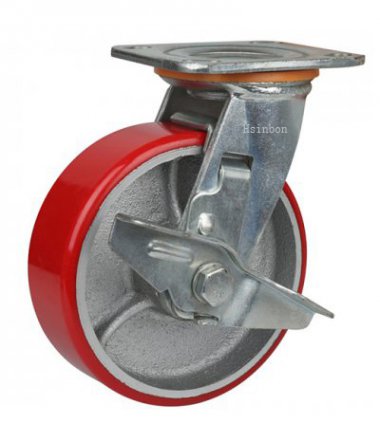
Material compatibility charts are provided with every quotation to ensure alignment with facility SOPs.
A chip fab uses a cart to transport reticles between bunkers. Even a single 0.1 µm particle causes yield loss.
FFIBU Solution: 4″ conductive polyurethane dual-wheel casters, 316 stainless steel, sealed bearings. Particle counts remained unchanged before/after implementation.
A fill-finish line requires a mobile isolator that withstands daily VHP decontamination.
FFIBU Solution: 5″ PTFE wheels, electropolished stainless yokes, zero-crevice design. Passed VHP cycle validation with no material degradation.
A DNA sequencing lab needs vibration-free mobility for sensitive optics.
FFIBU Solution: 4″ glass-filled nylon wheels with precision ball bearings, non-marking tread. Vibration measured at < 0.5 µm/sec during movement—well below instrument tolerance.
Laboratories value quiet, low-effort movement. FFIBU optimizes ergonomics through:
Precision-Machined Raceways: Reduce swivel torque by up to 40%.
Low Rolling Resistance Compounds: Minimize push force, especially important for frequent short-distance moves.
Quiet Wheel Formulations: TPE and nylon wheels operate below 45 dB—quieter than normal conversation.
These features reduce operator fatigue and prevent disturbance to sensitive experiments.
Pharmaceutical and medical device manufacturers require extensive documentation. FFIBU provides:
Material Certificates (MTCs): Mill test reports for stainless steel.
Compliance Statements: ISO 14644, FDA, RoHS, REACH.
Lot Traceability: Full material and process history for every caster.
Custom Validation Protocols: Support for IQ/OQ/PQ validation packages.
This documentation simplifies regulatory submissions and audit readiness.
In cleanrooms and laboratories, mobility should never come at the cost of contamination, instability, or non-compliance. Casters are not commodity items—they are precision components that must uphold the same rigorous standards as the processes they serve.
China Zhongshan FFIBU Casters Co., Ltd has dedicated significant R&D resources to mastering the unique demands of controlled environments. Every FFIBU cleanroom and laboratory caster is engineered to minimize particle generation, resist aggressive sterilization, control static, and deliver stable, ergonomic movement. From semiconductor fabs to sterile compounding pharmacies, FFIBU enables facilities to mobilize critical equipment without compromising the integrity of their most sensitive work.
When the environment demands perfection, trust the mobility solution engineered to preserve it.
 中文简体
中文简体  English
  Español
  العربية
  Français
  Русский
  Português
  Deutsch
  日本語
日本語  한국어
한국어  Tiếng Việt
  हिन्दी
  Italiano
  Nederlands
  Türkçe
  Polski
  ไทย
ไทย  Română
  বাংলা
বাংলা  Українська
  עברית
עברית  Lietuvių
  Bahasa Indonesia
  Svenska
  Magyar
  Dansk
Dansk  Suomi
Suomi  Čeština
  Ελληνικά