Select Language
When specifying casters for industrial carts, 3D printer enclosures, parcel handling systems, or medical equipment, one of the most misunderstood — yet critically important — parameters is wheel hardness. Expressed in Shore A (soft to medium polymers) or Shore D (hard polymers and plastics), hardness directly influences rolling resistance, floor protection, noise level, load capacity, shock absorption, and wear life.
Choosing the wrong durometer can result in loud, floor-damaging wheels on a polished warehouse floor, or soft wheels that flatten and wear prematurely under heavy loads. This guide explains what Shore A and Shore D mean, how they feel and perform in real applications, and how to match them to your equipment — the same methodology China Zhongshan FFIBU Casters Co., Ltd applies when engineering FFIBU caster series for global customers.
Shore hardness is a measure of a material's resistance to indentation, determined by pressing a calibrated indenter into the material under a specified spring force.
Shore A: Used for softer elastomers — rubber, TPR (thermoplastic rubber), soft polyurethane, EVA. Scale from 0 (gummy) to 100 (pencil-eraser hard).
Shore D: Used for harder plastics and very hard urethanes — nylon, polypropylene, hard PU, phenolic. Scale from 0D (≈95A) to 100D (rigid plastic/metal-like).
📌 Approximate crossover: Shore A 95–100 ≈ Shore D 40–45. A Shore D 60 wheel is significantly harder than a Shore A 95 wheel.
Wheel Material | Typical Hardness | Feel / Character |
|---|---|---|
Soft Rubber (natural/SBR) | Shore A 60–75 | Very soft, high grip, absorbs vibration, high rolling resistance |
Thermoplastic Rubber (TPR/TPE) | Shore A 75–85 | Quiet, good floor protection, moderate wear |
Standard Polyurethane (PU) | Shore A 90–95 / Shore D 45–50 | Balanced: quiet, wears well, good load capacity |
High-Density PU / Vulkollan®-type | Shore A 98–100 / Shore D 55–60 | High load, low compression, less shock absorption |
Nylon / Polypropylene | Shore D 70–80 | Very hard, low rolling resistance, noisy, no shock absorption |
Phenolic / Cast Iron | Shore D 80–90+ | Rigid, industrial-only, damages soft floors |
FFIBU caster wheels for 3D printer enclosures and parcel handling systems typically use engineered PU in the Shore A 92–95 / Shore D 48–52 range — optimized for vibration damping, non-marking performance, and long service life on coated concrete.
Harder wheels (Shore D >55, high-duro PU) deform less under load → lower rolling resistance → easier to push / less energy for AGVs.
Softer wheels (Shore A <80) flatten more → higher rolling resistance → more effort / higher drive torque.
Soft to medium (Shore A 75–90): Conforms slightly to floor texture, spreads load, unlikely to gouge or scratch — ideal for epoxy, tile, wood, polished concrete.
Hard (Shore D >65, nylon, phenolic): Can chip or leave skate marks on soft/coated floors — acceptable only on bare unfinished concrete.
Softer (A 65–85): Absorb small bumps, reduce transmitted vibration — preferred where noise or machine sensitivity (e.g., 3D printers) matters.
Harder (D 60+): Transmit impact and vibration through the frame — can cause layer-shift in precision equipment or discomfort in manual carts.
Harder compounds support higher dynamic loads before permanent deformation ("flat spotting").
Very soft wheels under overload develop flat spots when left stationary under load for long periods (cold flow).
Medium-hard PU (A 90–95) offers best overall abrasion resistance on clean/dusty floors.
Soft rubber picks up debris (hair, grit) more easily; nylon shrugs off debris but is unforgiving on obstacles.
Application | Recommended Hardness | Rationale |
|---|---|---|
3D Printer Enclosures / Lab Equipment | Shore A 85–92 (PU or TPE) | Damp vibration, quiet, non-marking, moderate load |
Parcel Handling / Warehouse Carts (indoor smooth) | Shore A 90–95 PU (Shore D 45–50) | Balance of load, roll-ease, floor protection |
AGV / AMR (autonomous mobile robot) | Shore A 95–98 PU / Shore D 50–58 | Low rolling resistance + consistent odometry; avoid too-soft PU |
Food / Wet / Washdown Carts | Shore A 80–88 TPR or white PU | Softer for grip on wet floors; non-porous compound |
Heavy Steel Mill / Foundry Trolleys | Shore D 70+ (nylon/steel/phenolic) | Maximum load, heat resistance; floor damage acceptable |
Hospital / Medical Carts | Shore A 75–85 TPR or soft PU | Ultra-quiet, non-marking, bump absorption |
Outdoor / Rough Concrete / Yard Carts | Shore A 80–88 (thick-tread rubber/PU) | Softer to absorb cracks/grates; not too soft to wear fast |
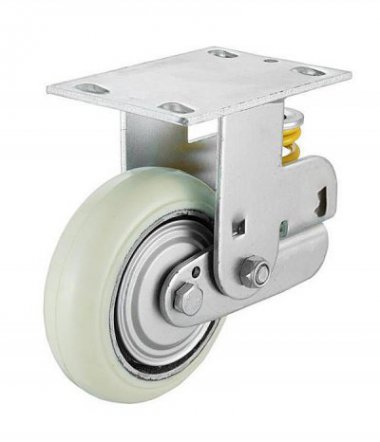
Flat Spotting: Soft urethane or rubber left under heavy static load for weeks can develop a temporary flat. Higher-durometer PU recovers faster; some compounds are formulated to resist this (FFIBU uses anti-flat-spot PU blends in high-load series).
Start-Up (Breakaway) Force: Softer wheels have higher initial rolling resistance — important for manual ergonomics. If push-force exceeds ~5–7% of total cart weight, consider a slightly larger diameter or harder compound within floor-safe limits.
Some FFIBU caster wheels use a dual-durometer construction:
Core: Rigid polypropylene or aluminum (structural)
Tread: Medium-hard PU (Shore A 92–95) bonded to core (shock absorption + load spread)
This gives the ergonomics of a resilient tread with the strength of a rigid core — ideal for parcel handling carts and mobile enclosures.
Tread profile also matters:
Crowned (rounded) tread → easier swiveling, lower start-up torque
Flat tread → more contact area, better stability for heavy static loads
If you already have sample wheels:
Press a thumbnail or pointed tool into the tread.
Easily indents → very soft (A <75) — good for vibration but watch load/flat-spot.
Slight indent, rebounds cleanly → medium PU (A 90–95) — generally ideal.
No visible indent → hard plastic/nylon (D 65+) — check floor compatibility.
Roll a loaded test cart:
Difficult to start rolling → too soft or too small a wheel.
Harsh vibration transmitted → too hard for sensitive equipment.
When specifying casters, ask:
✅ What is the floor type — polished concrete, tile, epoxy, rough outdoor?
✅ Is noise or vibration damping critical (lab, office, 3D printer)?
✅ What is the max load per caster (to avoid over-compression of soft tread)?
✅ Is the cart manually pushed or AGV-powered (affects acceptable rolling resistance)?
✅ Will the cart sit stationary under load for long periods (risk of flat spot)?
Matching durometer to these answers ensures optimal performance. For most indoor industrial and commercial uses, Shore A 90–95 non-marking polyurethane is the "goldilocks zone" — and is the default recommendation in the FFIBU product selection chart from China Zhongshan FFIBU Casters Co., Ltd.
 中文简体
中文简体  English
  Español
  العربية
  Français
  Русский
  Português
  Deutsch
  日本語
日本語  한국어
한국어  Tiếng Việt
  हिन्दी
  Italiano
  Nederlands
  Türkçe
  Polski
  ไทย
ไทย  Română
  বাংলা
বাংলা  Українська
  עברית
עברית  Lietuvių
  Bahasa Indonesia
  Svenska
  Magyar
  Dansk
Dansk  Suomi
Suomi  Čeština
  Ελληνικά