Select Language
Why Caster Material Determines Noise Level
When a cart rolls across a hard floor (concrete, tile, epoxy), the dominant sound source is the wheel tread contacting the floor surface — not the swivel raceway or bearings (though those matter too). The harder the wheel material, the less it deforms on contact, and the more impact vibration is transmitted as audible noise. Softer, elastomeric treads absorb micro-imperfections and dampen sound.
Typical measured rolling noise (A-weighted dB, ~1 m distance, cart rolling on smooth concrete or VCT at walking speed):
Wheel Material | Typical Shore Hardness | Approx. Rolling Noise | Subjective |
|---|---|---|---|
Soft Rubber / Neoprene | Shore A 60–70 | 38–46 dB | Very Quiet |
TPR / Thermoplastic Rubber (Soft PU) | Shore A 75–85 | 42–50 dB | Quiet / Whisper |
Polyurethane (Std. PU) | Shore A 90–95 / D 45–50 | 48–56 dB | Low / Acceptable |
Phenolic Resin | Shore D 80–90 | 60–68 dB | Noticeably Loud |
Nylon / Glass-Filled Nylon | Shore D 70–80 | 65–75 dB | Loud / Clicky |
Forged Steel / Cast Iron | Shore D 90+ | 70–80+ dB | Very Loud / Clattery |
⚠️ Actual dBA varies with floor roughness, cart speed, load, wheel diameter, and bearing type. Values above are representative of typical indoor conditions.
High elasticity absorbs floor micro-joints and seams.
Naturally dampens both rolling and impact noise.
Trade-off: Lower load capacity, wears faster, can leave marks if not "non-marking" grade, picks up debris.
Best for: hospitals, libraries, labs, offices — light loads only.
TPR mimics rubber's softness with better non-marking properties and wear life.
Softer PU (Shore A 80–85) also falls in this band — absorbs vibration well.
FFIBU TPR and soft-PU series are popular for medical carts, museum display movers, and office AV racks where silence is prioritized over maximum load.
Best for: patient wards, quiet zones, retail display, light institutional carts.
The industry "sweet spot." Slightly louder than TPR/rubber but vastly more durable and higher load-capable.
Non-marking PU (A 90–95) on polished/epoxy floors is the default FFIBU recommendation for 3D printer enclosures, parcel handling carts, and warehouse trolleys — balancing quiet operation with longevity and floor safety.
Larger diameter PU rolls quieter (spans joints, fewer impacts/sec).
Best for: general industrial, logistics, labs with moderate noise sensitivity.
Rigid, no dampening — every floor joint produces a sharp "tick."
Acceptable only where noise is not a concern and floor marking is irrelevant.
Best for: high-heat areas, food plants (washdown-rated phenolic), heavy-load warehouse where noise is tolerated.
Extremely hard → minimal tread deformation → maximum rolling efficiency but maximum acoustic output.
On tile or terrazzo the "clack-clack" over expansion joints is pronounced.
Can induce structure-borne noise transmitted through cart frame.
Best for: heavy-duty concrete-floor warehouses where noise is not a concern and floor marking is acceptable.
Metal-on-concrete or metal-on-metal contact — screeching, grinding, or rumbling.
Used only in foundries, rail yards, extreme heavy-industry — never in occupied/office areas.
Factor | Effect on Noise |
|---|---|
Wheel Diameter | ↑ Diameter ↓ Impact frequency — an 8" (200 mm) wheel is typically 3–5 dB quieter than a 4" (100 mm) same-material wheel on the same floor |
Bearings | Worn, dry, or debris-contaminated bearings create squeak; sealed precision ball bearings are quietest |
Swivel Raceway | Kingpin wear or lack of lubrication causes metallic "clunk" on turns — use kingpinless or lubricated precision raceways |
Floor Condition | Expansion joints, cracks, and grates cause impact spikes regardless of wheel — softer treads mask them better |
Speed | Faster rolling = higher dB, especially with hard wheels; soft treads absorb more at low-to-moderate speeds |
Load | Overloaded soft wheels flatten excessively → increased tread-face "slap" on rotation; correctly sized wheels are quieter |
Environment | Priority | FFIBU Recommended Wheel |
|---|---|---|
Hospital wards, libraries, offices | Minimize dB | TPR or Soft PU (A 75–85), Ø ≥100 mm, sealed ball bearings |
Labs, 3D printer enclosures, cleanrooms | Low noise + floor-safe + medium load | Non-marking PU (A 90–93), crowned tread, precision bearings |
Warehouse / logistics (indoor smooth) | Balance noise + durability + load | Std PU (A 93–95 / D 48–52), Ø ≥125 mm |
Heavy industrial (concrete, no noise limit) | Max load, min cost | Nylon or Phenolic — accept higher noise |
Mixed carpet + hard floor (offices/schools) | Compromise | Med-hard non-marking PU (A 93–95), Ø 125–150 mm |
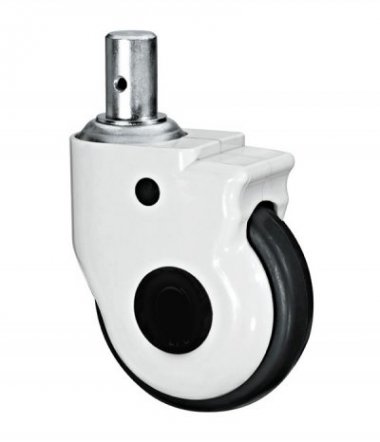
Softest / Quietest: Soft Rubber ≈ TPR (Shore A 65–80) — ≤46 dB, light-duty only
Best All-Round Low-Noise Choice: Non-marking Polyurethane (Shore A 90–95) — 48–56 dB, excellent load & wear
Loudest: Nylon / Phenolic / Steel — 60–75+ dB, avoid in noise-sensitive areas
For applications where both acoustics and durability matter — such as the FFIBU caster ranges supplied by China Zhongshan FFIBU Casters Co., Ltd — the engineered non-marking PU formulation at Shore A 90–93 consistently delivers the optimal compromise: perceptibly quieter than nylon/phenolic, far more durable than soft rubber, and safe for finished floors.
 中文简体
中文简体  English
  Español
  العربية
  Français
  Русский
  Português
  Deutsch
  日本語
日本語  한국어
한국어  Tiếng Việt
  हिन्दी
  Italiano
  Nederlands
  Türkçe
  Polski
  ไทย
ไทย  Română
  বাংলা
বাংলা  Українська
  עברית
עברית  Lietuvių
  Bahasa Indonesia
  Svenska
  Magyar
  Dansk
Dansk  Suomi
Suomi  Čeština
  Ελληνικά