Select Language
Many buyers focus only on load capacity when selecting a caster and treat wheel diameter as an afterthought. In reality, caster size (wheel diameter and tread width) is a decisive factor in:
✅ Ease of pushing / pulling (rolling & start-up resistance)
✅ Ability to overcome floor obstacles, thresholds & expansion joints
✅ Vibration transmission to sensitive equipment
✅ Floor protection & point loading
✅ Equipment overall height & stability
A properly sized wheel makes a 300 kg cart feel easy to move; an undersized wheel can make a 100 kg cart exhausting and damaging to floors. This guide explains how to match caster size to your application, based on the same engineering approach used by China Zhongshan FFIBU Casters Co., Ltd when specifying FFIBU caster series.
All else being equal:
Larger diameter wheels reduce rolling resistance.
They deform less at the contact patch and bridge gaps more easily → lower push/pull force.
Larger wheels reduce start-up (breakaway) force slightly on smooth floors, and significantlywhen crossing thresholds or carpet.
Larger wheels hit floor joints less frequently per unit distance, resulting in fewer micro-impacts and less vibration transmitted to the equipment.
⚠️ Trade-off: Larger wheels raise the equipment's center of gravity and require more swivel space. Always verify that overall height + equipment clearance is acceptable.
Wheel Ø | Common Name | Typical Total Load (4-caster set) | Best Suited For |
|---|---|---|---|
2"–3" (50–75 mm) | Mini / Furniture | < 80–100 kg | Office chairs, light instrument stands, small cabinets (hard floor only) |
3"–4" (75–100 mm) | Light Duty | 80–200 kg | Medical crash carts, AV racks, light service trolleys |
5" (125 mm) | Medium Duty | 200–400 kg | Workshop carts, parcel handling, mobile workbenches |
6"–8" (150–200 mm) | Heavy Duty | 400–800 kg | Die carts, mold-change trolleys, large 3D printer enclosures, AGVs |
10"+ (250+ mm) | Extra Heavy / Special | 800–2,000+ kg | Coil handling, aircraft tooling, heavy machinery bases |
3D Printer Enclosures (medium format): 5" (125 mm) non-marking PU — low vibration, easy to roll on epoxy floor, fits under enclosure base.
Parcel Handling Carts (300–500 kg): 6" (150 mm) PU — bridges dock plates and floor joints, reduces operator fatigue.
Laboratory / Medical Carts: 4"–5" (100–125 mm) TPR or soft PU — quiet, low-profile, ergonomic.
To roll over a raised threshold, door saddle, or expansion joint without jarring impact:
Wheel diameter should be at least 3× the obstacle height for comfortable passage.
Minimum acceptable: wheel Ø ≥ 2× obstacle height (will feel harsh).
Obstacle Height | Minimum Recommended Ø | Comfortable Ø |
|---|---|---|
3 mm (⅛") | 75 mm (3") | 100 mm (4") |
5 mm (≈¼") | 100 mm (4") | 125 mm (5") |
10 mm (⅜–½") | 125 mm (5") | 150 mm (6") |
15–20 mm (¾–⅞") | 150 mm (6") | 200 mm (8") |
If your cart must regularly cross dock plates, metal thresholds, or elevator sills, default to 6" (150 mm) minimum for anything above light duty.
Hard floor: Smaller diameters (4" / 100 mm) are often acceptable if load is modest and floor is smooth.
Carpet (especially medium/high pile):
→ Use minimum 5" (125 mm) on low-pile commercial carpet
→ 6" (150 mm)+ on medium or plusher carpet
→ Larger diameter prevents "plowing" into the pile and reduces push force dramatically.
📌 Mixed carpet + hard floor routes → choose carpet-appropriate diameter (typically 125–150 mm) with medium-hard non-marking PU (Shore A 93–95).
Tread width is secondary to diameter but still important:
Tread Width | Typical Use |
|---|---|
20–25 mm (¾–1") | Light duty, furniture, instrument carts |
30–38 mm (1¼–1½") | General medium-duty carts, parcel handling |
40–50 mm (1½–2") | Heavy-duty / dual-wheel casters, high-load trolleys |
50+ mm | Extra-heavy coil/steel mill cars |
Wider tread:
Spreads load slightly → better for soft floors / raised-access floors
Increases lateral stability on heavy carts
Narrower tread:
Easier swiveling in tight aisles
Less likely to catch in narrow grate openings
For most FFIBU general-purpose PU casters:
4"–5" wheels → 32 mm tread
6"–8" wheels → 38–40 mm tread
Heavy-duty 8"+ → 45–50 mm tread
Before finalizing size:
Overall Height = Wheel Radius + Yoke Height + Top Plate Thickness
Ensure: Equipment Base Height − Mounting Recess ≥ Overall Height
Stability:
Larger wheels raise the deck height → improves obstacle clearance but raises center of gravity.
For tall, narrow equipment → keep wheel size reasonable and ensure adequate base footprint.
For low-profile equipment (e.g., some 3D printer enclosures) → use max diameter that still fits under the base.
Prefer 5"–6" (125–150 mm) PU — larger wheel absorbs floor joints better → less vibration transmitted.
Avoid oversized wheels if they raise the enclosure too high (check leveling foot provision).
Larger diameter → lower rolling resistance → smaller drive motor / longer battery life.
FFIBU AGV-series typically: Ø 150–200 mm, precision ball bearings, controlled tread hardness (Shore A 95 / D 50–55).
May need to accept slightly smaller diameter for clearance, but compensate by:
Using harder PU (still non-marking)
Ensuring load rating is adequate
Installing 2 swivel + 2 rigid (directional lock optional)
Size selected normally per load & floor — but specify sealed bearings, stainless or zinc-plated yoke, and cold-resistant compound if applicable.
Weigh your loaded equipment → calculate required dynamic load per caster (see separate Load Capacity guide).
Identify worst-case floor obstacle / carpet type → apply threshold rule (Ø ≥ 3× obstacle height).
Check equipment ground clearance → max allowable overall height.
Select smallest standard diameter that satisfies steps 2 & 3 AND meets load requirement.
Verify tread width is appropriate for load & floor type.
Confirm swivel radius / mounting plate fits your equipment base.
Application | Recommended Ø | Tread | Material (Typical) |
|---|---|---|---|
Office / Furniture / Light Instrument | 3"–4" (75–100 mm) | 20–25 mm | TPR or Soft PU (A 78–85) |
Medical / Lab Cart | 4"–5" (100–125 mm) | 25–32 mm | TPR or PU (A 80–90) |
Parcel Handling / Workshop Cart | 5"–6" (125–150 mm) | 32–38 mm | Non-marking PU (A 92–95) |
3D Printer Enclosure (mid–large) | 5"–6" (125–150 mm) | 32–38 mm | Damping PU (A 88–93) |
Heavy Die / Mold / AGV | 6"–8" (150–200 mm) | 38–50 mm | Hard PU (A 95–98 / D 50–58) or Nylon |
Outdoor / Rough Terrain | 8"–10"+ (200–250+ mm) | 50+ mm | Pneumatic or Flat-Free Elastomer |
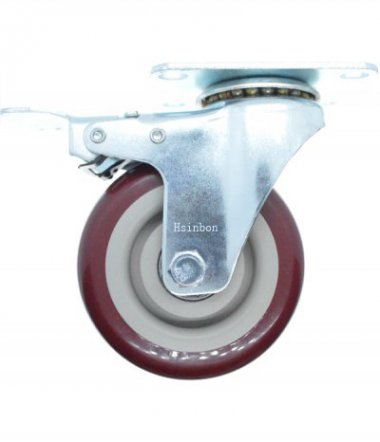
The "right" caster size is the smallest standard diameter that:
Meets or exceeds the dynamic load requirement,
Clears your floor's worst obstacle or carpet pile comfortably,
Fits within your equipment's height envelope, and
Provides acceptable ergonomics and vibration control.
Choosing correctly improves daily usability, reduces worker injury risk, and protects both your floors and your equipment. When in doubt, the technical team at China Zhongshan FFIBU Casters Co., Ltd can review your load, floor, and dimensional constraints and recommend the optimal FFIBU size and model.
 中文简体
中文简体  English
  Español
  العربية
  Français
  Русский
  Português
  Deutsch
  日本語
日本語  한국어
한국어  Tiếng Việt
  हिन्दी
  Italiano
  Nederlands
  Türkçe
  Polski
  ไทย
ไทย  Română
  বাংলা
বাংলা  Українська
  עברית
עברית  Lietuvių
  Bahasa Indonesia
  Svenska
  Magyar
  Dansk
Dansk  Suomi
Suomi  Čeština
  Ελληνικά