Select Language
Many caster failures have nothing to do with load capacity and everything to do with floor incompatibility. A caster that performs flawlessly on bare concrete can destroy an epoxy-coated showroom floor—or vice versa, a soft wheel perfect for polished tile may wear out in weeks on abrasive broom-finished concrete.
Before choosing wheel diameter, bearing type, or brake style, you must first identify:
Floor material & finish
Floor condition (smooth / cracked / uneven / grated)
Cleanliness (dusty, oily, wet, debris-prone)
Sensitivity (noise, marking, electrostatic control)
This guide walks through common floor types found in factories, warehouses, labs, hospitals, offices, and outdoor yards—and matches each with the optimal wheel material, hardness, and caster configuration, based on the same application-engineering standards used by China Zhongshan FFIBU Casters Co., Ltd when specifying FFIBU caster solutions.
Characteristics:
Very smooth, hard surface
Easily scratched or marked by hard wheels
Often in climate-controlled, clean environments
Best Wheel Choice:
✅ Non-marking Polyurethane (PU), Shore A 90–95
✅ Crowned tread, ball-bearing raceway
✅ Optional: TPR (Thermoplastic Rubber), Shore A 78–85 for ultra-quiet needs
Why:
Medium-hard PU conforms slightly to micro-imperfections, protects the coating, rolls easily, and resists chunking. TPR is even quieter but wears faster under heavy loads.
Avoid:
❌ Nylon / Polypropylene / Phenolic — will leave black or gray skate marks and may gouge the coating
❌ Soft rubber (<Shore A 70) — picks up debris, higher rolling resistance
FFIBU Recommendation:
FFIBU light-to-medium duty PU series with non-marking tread, sealed bearings for dust-free environments—ideal for parcel handling carts, mobile 3D printer enclosures, and lab workstations.
Characteristics:
Abrasive surface with minor pitting or aggregate exposure
Tolerates harder wheels
May have expansion joints, oil stains, or dust
Best Wheel Choice:
✅ High-durometer PU (Shore A 95–98 / Shore D 50–58) for heavy loads & long life
✅ Nylon (Shore D 70–75) for lowest rolling resistance in non-sensitive areas
✅ Larger diameter (≥6" / 150 mm) to bridge joints and pits
Why:
Abrasive concrete chews up soft rubber quickly. Harder PU or nylon resists wear and rolls easily under heavy loads. Larger wheels reduce vibration from surface texture.
Caution with Nylon:
Only use if floor marking is acceptable and noise is not a concern.
FFIBU Recommendation:
FFIBU heavy-duty PU or nylon-series casters with reinforced yokes and precision ball bearings—designed for high-cycle parcel sortation carts and mold-change trolleys.
Characteristics:
Smooth but relatively soft or delicate finishes
Zero tolerance for scratching or marking
Often require quiet operation
Best Wheel Choice:
✅ Soft TPR or Soft PU, Shore A 75–85
✅ Non-marking, non-staining formulation
✅ Swivel casters with precision bearings for effortless turning
Why:
Soft tread distributes load gently, prevents indentations on vinyl/wood, and minimizes noise. TPR is especially good on ceramic tile grout lines.
Avoid:
❌ Anything Shore D >60 (nylon, phenolic, hard PU) — high risk of scratching or "clicking" on grout lines
❌ Wheels with metal chips or embedded grit in tread
FFIBU Recommendation:
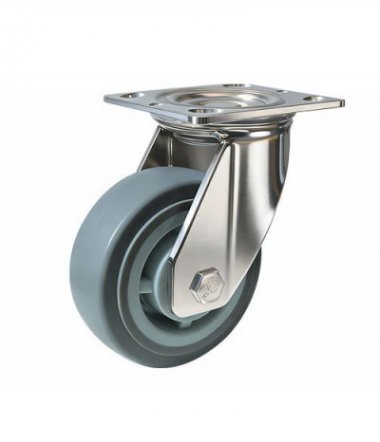
FFIBU institutional / medical-grade TPR or soft-PU casters with chrome or stainless steel top plates—suited for mobile medical carts, AV racks, and display units.
Characteristics:
Modular panels, slight flex under point loads
Often requires ESD (Electrostatic Discharge) control
Sensitive to concentrated pressure
Best Wheel Choice:
✅ Conductive PU (carbon-filled), Shore A 90–93
✅ Wider tread footprint to reduce point load
✅ Grounded metal yoke or bracket
Why:
Conductive wheels safely dissipate static. Softer-than-nylon durometer protects panel edges. Wider tread reduces risk of panel deflection or cracking.
Avoid:
❌ Standard insulating rubber or untreated nylon
❌ Very narrow, small-diameter wheels—concentrate load on panel corners
FFIBU Recommendation:
FFIBU ESD-safe caster series with conductive PU tread and resistive-tested grounding path—used in SMT lines and server rack trolleys.
Characteristics:
Frequently hosed down with hot water / caustic cleaners
May be slippery when wet
Corrosion risk for brackets
Best Wheel Choice:
✅ Stainless steel (304/316) caster fork + White / Blue FDA-grade PU or TPR, Shore A 80–88
✅ Sealed bearings
✅ Tread with good wet-grip (avoid overly slick hard PU)
Why:
SS brackets resist rust from chlorinated cleaners. Slightly softer tread improves traction on wet tile. Non-porous wheel resists bacterial harborage.
Special Case – Cold Storage (<0°C / 32°F):
Use cold-resistant PU or rubber formulated to stay flexible; standard PU may harden and crack.
FFIBU Recommendation:
FFIBU washdown / cold-storage caster lines with SS forks, grease-free bearings, and low-temp-resistant treads.
Characteristics:
Cracks, expansion joints, occasional gravel or grate crossings
Often dirty, oily, or sun-exposed
Need shock absorption and obstacle clearance
Best Wheel Choice:
✅ Pneumatic (air-filled) or Solid Elastomeric (flat-free) tires for very rough terrain
✅ Large-diameter soft rubber or thick-tread PU, Shore A 75–82 when pneumatic is impractical
✅ Spring-loaded or shock-absorbing caster yokes for sensitive payloads
Why:
Softer, larger wheels absorb shock and bridge gaps. Pneumatics excel on gravel/dirt but require maintenance; solid elastomeric is puncture-proof.
Avoid:
❌ Small hard wheels (nylon, hard PU <5") — transmit harsh vibration, can wedge in grates
❌ Precision ball-bearing swivels in muddy environments unless sealed — prefer shielded or roller bearings
FFIBU Recommendation:
FFIBU heavy-duty pneumatic or cushion-tire casters with zinc-plated corrosion-resistant forks for outdoor material handling and aircraft-tooling dollies.
Characteristics:
Open or patterned metal
Hard, unforgiving surface
Small wheels can lodge in openings
Best Wheel Choice:
✅ Medium-hard PU (Shore A 93–96) or Nylon, Ø ≥ 5" (125 mm)
✅ Tread width sufficient to span gaps
✅ Check open-area dimension vs. wheel width to prevent wedging
Why:
Hard enough to resist deformation on metal; large diameter prevents dropping into grate openings.
FFIBU Recommendation:
FFIBU forged-steel-yoke casters with PU or nylon wheels for aircraft hangar tooling carts and steel-service-center dollies.
Floor Type | Recommended Tread Material | Hardness (Shore) | Key Benefit |
|---|---|---|---|
Epoxy / Polished Concrete | Non-marking PU | A 90–95 | Floor-safe, quiet, long wear |
Bare / Broom Concrete | Hard PU or Nylon | A 95–98 / D 50–75 | Abrasion resistant, easy roll |
Tile / Vinyl / Wood | TPR or Soft PU | A 75–85 | Non-marking, gentle, quiet |
Raised Access / ESD Floor | Conductive PU | A 90–93 | ESD-safe, low point load |
Wet / Washdown / Cold | SS + FDA PU / TPR | A 80–88 (cold-formula) | Corrosion-proof, slip-resistant |
Outdoor / Rough / Gravel | Pneumatic or Soft Elastomer PU | A 70–82 | Shock absorb, obstacle clear |
Metal Grate / Diamond Plate | Med-hard PU or Nylon | A 93–96 / D 60+ | Bridge gaps, resist wear |
☑ Check floor cleanliness — dusty abrasive floors shorten soft-wheel life; consider debris guards or sealed bearings
☑ Verify threshold heights — if door saddles > 3–5 mm exist, minimum 6" (150 mm) wheel recommended
☑ Confirm slope / ramp presence — requires total-lock brakes regardless of floor type
☑ Note floor joints / expansion gaps — measure gap width vs. wheel diameter to prevent pinching
☑ Consider acoustics — offices & labs favor TPR/A 78–82; heavy industry tolerates nylon
There is no "universally best" caster wheel—only the best match for your floor. The wrong combination accelerates floor damage, increases push force, generates noise complaints, or causes premature caster failure. The right match, engineered for your specific substrate and operating environment, pays back in lower maintenance, safer operation, and smoother daily workflow.
China Zhongshan FFIBU Casters Co., Ltd backs every FFIBU caster with application-specific guidance—so you don't have to guess. Send us your floor type, total load, number of casters, and whether the unit is manually pushed or AGV-driven, and our engineering team will recommend the correct FFIBU model and wheel specification for your project.
 中文简体
中文简体  English
  Español
  العربية
  Français
  Русский
  Português
  Deutsch
  日本語
日本語  한국어
한국어  Tiếng Việt
  हिन्दी
  Italiano
  Nederlands
  Türkçe
  Polski
  ไทย
ไทย  Română
  বাংলা
বাংলা  Українська
  עברית
עברית  Lietuvių
  Bahasa Indonesia
  Svenska
  Magyar
  Dansk
Dansk  Suomi
Suomi  Čeština
  Ελληνικά