Select Language
One of the most common caster mismatches occurs when a wheel chosen for a hard, smooth floor is used on carpet—or vice versa.
On hard floors, the priority is floor protection, low noise, and minimal rolling resistance.
On carpeted surfaces, the priority shifts to overcoming pile friction, preventing sinking, and maintaining reasonable push effort.
Using a soft, small-diameter wheel on plush carpet can make a loaded cart nearly impossible to push. Using a hard, narrow, small wheel on a finished hard floor can scuff, scratch, or leave black marks. This guide explains how to choose correctly for each—and what to do when equipment must travel on both.
The recommendations below follow the same application-engineering standards used by China Zhongshan FFIBU Casters Co., Ltd when specifying FFIBU caster solutions for offices, labs, hospitals, hotels, schools, and industrial facilities.
(Polished Concrete, Epoxy, Tile, Vinyl, Laminate, Hardwood, Terrazzo)
Smooth, non-deformable surface
Easily scratched or marked by hard wheel materials
Low rolling resistance naturally—but sensitive to noise & vibration
Often require non-marking, hygienic, or ESD properties
✅ Non-marking Polyurethane (PU) — Shore A 90–95 (ideal "goldilocks" range)
✅ Thermoplastic Rubber (TPR) / Soft PU — Shore A 75–85 (quiet, extra floor-safe; slightly higher push force)
✅ Conductive PU — for ESD / raised-access floors (Shore A 90–93)
Need | Hardness | Material |
|---|---|---|
General industrial / warehouse (epoxy/concrete) | Shore A 90–95 | Non-marking PU |
Quiet labs, hospitals, offices (tile/wood/vinyl) | Shore A 75–85 | TPR or soft PU |
ESD-sensitive areas (electronics mfg, data center) | Shore A 90–93 | Conductive PU (carbon-filled) |
❌ Nylon / Phenolic / Polypropylene — very noisy, can gouge or leave skate marks
❌ Soft natural rubber (<Shore A 70) — high rolling resistance, picks up debris, may leave oily residue over time
❌ Very small wheels (<3" / 75 mm) — increase point loading; can leave indentations on soft vinyl/wood
Light duty (≤150 kg total): 4" (100 mm) minimum
Medium duty (150–400 kg): 5"–6" (125–150 mm) preferred for easier swiveling & lower start-up force
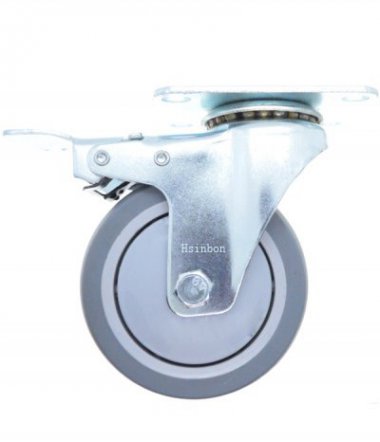
FFIBU light/medium-duty PU or TPR series with:
Non-marking tread
Precision ball bearings
Zinc-plated or stainless top-plate yoke
Optional total-lock brake
Ideal for: mobile 3D printer enclosures, parcel handling carts on epoxy floors, lab benches, office AV racks.
(Low-Pile Commercial Carpet, Medium-Pile Office Carpet, Berber, Plus High-Pile / Plush)
Carpet pile creates continuous frictionagainst the wheel tread
Soft padding allows small/narrow wheels to sink in ("plowing" effect)
Start-up (breakaway) force is significantly higher than on hard floors
Risk of fiber wrapping around axles on some carpet types
✅ Harder Polyurethane (Shore A 95–98 / Shore D 50–58) — resists sinking, easier to roll on low-pile
✅ Nylon (Shore D 70–75) — lowest rolling resistance on low-pile commercial carpet; NOT for delicate hard floors
✅ Large-diameter soft rubber or TPR — acceptable on low-pile only, if push effort is manageable
⚠️ Softer wheels (Shore A <85) can be used on very low-pile, thin commercial carpet, but expect noticeably higher push force under load.
Carpet Type | Minimum Recommended Diameter |
|---|---|
Low-pile / commercial loop (office) | 5" (125 mm) preferred; 4" (100 mm) OK for light loads |
Medium-pile cut / twist carpet | 6" (150 mm) minimum |
High-pile / plush / thick pad | 8" (200 mm) or consider furniture glides / remove casters |
Larger diameter:
Reduces sink-in depth
Lowers effective rolling resistance
Bridges carpet-to-hard-floor transitions more smoothly
Wider tread helps distribute load slightly on compressible carpet backing, but diameter is more important than width for carpet performance.
Use sealed ball bearings or shielded roller bearings to prevent carpet fibers from migrating into the axle bore.
Some FFIBU models include fiber guards / axle covers for hospitality and office applications.
❌ Small (2"–3" / 50–75 mm) soft rubber wheels — will "plow" into pile
❌ Unsealed plain bearings on berber/loop carpet — fibers pack in quickly
FFIBU medium/hard-durometer PU or nylon series with:
Larger wheel diameter (≥5" / 125 mm for offices)
Sealed/precision bearings
Reinforced yoke for lateral loads during turning on carpet
Optional fiber guards
Ideal for: hotel housekeeping carts, office mobile pedestals, AV carts rolling through carpeted corridors.
Many carts (offices, schools, hospitals, hotels) must transition between carpeted hallways and tiled/stone lobbies or restrooms.
Parameter | Compromise Choice |
|---|---|
Wheel Material | Non-marking Polyurethane, Shore A 93–95 — hard enough to roll on low-pile carpet, soft enough to be safe on tile/vinyl |
Diameter | 5"–6" (125–150 mm) — bridges carpet pile and rolls easily on hard floors |
Tread Profile | Slightly crowned — lowers start-up torque on carpet, still floor-safe |
Bearings | Sealed ball bearings — resists carpet fibers, rolls smoothly on hard floors |
Brakes | Total-lock (wheel + swivel) — essential when stopping on hard smooth floors |
⚠️ If the route includes high-pile plush carpet, even A 95 PU on 5" may feel stiff—consider 6" minimum or evaluate whether the cart really needs to go there.
❌ Nylon — will mark/damage hard floors in lobbies & patient rooms
❌ Very soft TPR (A <80) — becomes hard to push on any carpet
❌ <4" wheels — problematic on both surfaces
FFIBU "multi-surface" PU caster series — engineered Shore A 93–95 non-marking PU, 125–150 mm diameter, crowned tread, sealed bearings, optional stainless or chrome finish. Suitable for hospital utility carts, mobile IT racks, and hotel service trolleys that travel between carpet and hard floor zones.
Factor | Hard Floor (Tile/Wood/Epoxy/Concrete) | Carpeted Floor (Low/Med Pile) | Mixed Carpet + Hard Floor |
|---|---|---|---|
Best Tread Material | Non-marking PU (A 90–95) or TPR (A 75–85) | Hard PU (A 95–98) or Nylon (D 70+) | Non-marking PU (A 93–95) |
Min. Diameter (typical) | 4" (100 mm) light; 5"+ preferred | 5" (125 mm) low-pile; 6"+ med-pile | 5"–6" (125–150 mm) |
Hardness Preference | Softer side of PU or TPR | Harder PU or Nylon | Medium-hard PU (A 93–95) |
Rolling Effort | Low | Higher (esp. small/soft wheels) | Moderate (correct sizing critical) |
Floor Damage Risk | Hard wheels (nylon/phenolic) = HIGH | Small/soft wheels = sink-in | Nylon on hard floor = damage |
Noise | TPR/soft PU quietest | Hard PU acceptable; nylon loud | PU A 93–95 good compromise |
Bearing Type | Ball or sealed ball | Sealed ball / shielded roller | Sealed ball |
If unsure:
Load a test cart to its maximum working load.
Push it on the worst-case carpet in your facility (usually thickest pile).
If start-up push force feels excessive (>~5–7% of total cart weight for manual ergonomics), increase wheel diameter or step up durometer slightly within floor-safe limits.
Verify the same wheel does not mark your most delicate hard floor (run back-and-forth on a sample tile/vinyl offcut).
Hard floors → protect the floor: choose non-marking, medium-soft to medium PU or TPR.
Carpet → overcome pile friction: choose larger diameter, harder PU or nylon (if hard floors are not a concern).
Both → compromise wisely: medium-hard non-marking PU + generous diameter + sealed bearings.
Making the right choice prevents daily frustration, protects your floors, and reduces worker strain. When in doubt, China Zhongshan FFIBU Casters Co., Ltd provides application-specific consultation and can recommend the correct FFIBU model based on your actual floor types, total load, number of casters, and whether the cart is manually pushed or AGV-assisted.
 中文简体
中文简体  English
  Español
  العربية
  Français
  Русский
  Português
  Deutsch
  日本語
日本語  한국어
한국어  Tiếng Việt
  हिन्दी
  Italiano
  Nederlands
  Türkçe
  Polski
  ไทย
ไทย  Română
  বাংলা
বাংলা  Українська
  עברית
עברית  Lietuvių
  Bahasa Indonesia
  Svenska
  Magyar
  Dansk
Dansk  Suomi
Suomi  Čeština
  Ελληνικά