Select Language
Adding casters to furniture is a popular and practical upgrade that transforms heavy or static pieces into mobile, versatile assets. Whether it's a workbench, a storage cabinet, a display island, or a home library ladder, the right casters enhance functionality and ease of use. Successful installation hinges on selecting appropriate hardware and following correct procedures to ensure safety, stability, and smooth operation. This guide outlines the key steps, incorporating considerations for quality components from manufacturers like China Zhongshan FFIBU Casters Co., Ltd.
Phase 1: Planning and Selection – The Foundation for Success
Before any drilling begins, careful planning ensures the project's success and the furniture's integrity.
Assess the Furniture:
Weight & Load: Calculate the total weight of the furniture itself plus the maximum weight it will hold (e.g., tools in a workshop cabinet, books on a cart). Divide this total by the number of casters you plan to install. The load capacity of each caster must exceed this result, with a safety margin for dynamic forces (e.g., starting, stopping).
Structure & Material: Evaluate the furniture's legs or base. Are they solid wood, particleboard, or metal? The material must be strong enough to handle the concentrated stress at the mounting points. For softer materials like particleboard, reinforcement plates or large washers are often necessary to distribute the load and prevent pull-through.
Desired Height & Clearance: Determine if you want to maintain the original height, increase it, or lower it. Caster height (from the mounting plate to the floor) directly affects this. Ensure there is adequate clearance for the caster to swivel freely without hitting the furniture's body or legs.
Choose the Right Caster:
Soft Tread (Polyurethane, Rubber): Perfect for protecting hardwood, tile, or laminate floors. They roll quietly and smoothly.
Hard Tread (Nylon, Phenolic): Best for durable, easy-rolling movement on carpet or in workshops. They can mark softer floors.
Threaded Stem: Ideal for pre-drilled holes in furniture legs. Requires knowing the exact stem diameter and thread (e.g., 3/8"-16, M10x1.5).
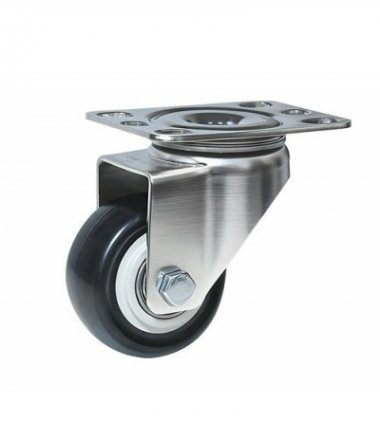
Top Plate (Plate Mount): More versatile for flat surfaces. The plate is screwed or bolted onto the bottom of the furniture. This provides a very stable and robust connection, especially for heavier pieces.
Type: For furniture, the two most common mounting types are Threaded Stem and Top Plate.
Wheel Material: Match the wheel to your floor type to prevent damage and ensure easy rolling.
Features: Consider locking casters (wheel brake and/or swivel lock) for stability when the furniture is in use.
Phase 2: The Installation Process
Gather your tools: measuring tape, pencil, drill, appropriate drill bits, screwdriver or wrench, and potentially a carpenter's square.
For Top Plate Mount Casters (Most Common Method):
Mark and Prepare the Mounting Points:
Turn the furniture upside down on a protected surface (like a blanket).
Decide on caster placement. They should be mounted as close to the corners as possible for maximum stability. Use a square to ensure the plate will be aligned straight with the furniture's edge.
Mark the center points for the pilot holes through the mounting holes on the caster plate. For plates with slotted holes, you have some adjustment room.
Drill Pilot Holes:
Select a drill bit slightly smaller in diameter than the screws provided. This ensures the screws will bite tightly into the material.
Drill straight pilot holes at your marked points to the recommended depth. For softwoods or particleboard, this step is crucial to prevent splitting.
Attach the Caster:
Position the caster plate over the pilot holes.
Insert the provided screws (use washers if included) and drive them in firmly until the plate is snug against the furniture base. Tighten screws in a diagonal pattern to ensure even seating. Avoid over-tightening, which can strip the material or warp the plate.
For Threaded Stem Mount Casters:
Prepare the Socket:
If the furniture leg does not have a pre-drilled hole, you must create one. The hole must match the core diameter of the stem (the non-threaded inner diameter), not the outer thread diameter.
Drill a clean, straight, and perpendicular hole to the correct depth. A drill press is highly recommended for accuracy.
Install the Stem:
Apply a small amount of carpenter's glue or a specialized thread-locking adhesive to the stem's threads for a permanent, secure fit. This prevents the caster from loosening over time.
Start the stem into the hole by hand, ensuring it is straight. Use an appropriate wrench to turn it until it is fully seated and tight. Do not overtighten.
Phase 3: Final Checks and Adjustment
Stability Test: Carefully right the furniture. Gently test for stability. The furniture should sit firmly on all casters without rocking. If it rocks, check that all casters are installed to the same depth and that the furniture's base is even.
Functional Test: Roll the furniture forward, backward, and in a circle. Movement should be smooth and quiet. Test any locking mechanisms to ensure they engage and disengage properly.
Floor Protection: Consider adding adhesive felt pads to the top plates (if visible) or the furniture base to prevent any marring when the caster swivels.
Conclusion: Enhancing Mobility with Confidence
Installing casters on furniture is a rewarding DIY project that significantly boosts utility. The key to a professional and durable result lies in selecting casters that match the load and environment, preparing the furniture properly, and executing a precise installation. By choosing well-designed casters engineered for consistent performance, you can confidently equip your furniture for a new life of easy mobility and enhanced functionality.
 中文简体
中文简体  English
  Español
  العربية
  Français
  Русский
  Português
  Deutsch
  日本語
日本語  한국어
한국어  Tiếng Việt
  हिन्दी
  Italiano
  Nederlands
  Türkçe
  Polski
  ไทย
ไทย  Română
  বাংলা
বাংলা  Українська
  עברית
עברית  Lietuvių
  Bahasa Indonesia
  Svenska
  Magyar
  Dansk
Dansk  Suomi
Suomi  Čeština
  Ελληνικά