Select Language
In the high-stakes environment of a commercial kitchen, every piece of equipment is a precision instrument—whether it’s a stainless-steel prep table, a blast chiller, or a 500-gallon stockpot. Yet one component is often treated as an afterthought: the caster. For chefs, facility managers, and equipment designers, casters are not just wheels; they are the silent enablers of efficiency, safety, and hygiene. A poorly chosen caster can derail a dinner service, damage flooring, or even trigger health code violations. A well-engineered one, by contrast, transforms how a kitchen operates.
This guide dives deep into the science and strategy of selecting casters for foodservice environments, with insights from China Zhongshan FFIBU Casters Co., Ltd—a global specialist in mobility solutions where the FFIBU brand has become synonymous with durability and culinary-specific design. We’ll explore material science, load dynamics, hygiene engineering, and real-world kitchen scenarios to help you make choices that stand up to the heat (literally and figuratively).
Commercial kitchens are unforgiving spaces. Temperatures swing from sub-zero walk-in freezers to 500°F pizza ovens. Floors are slick with grease, water, and food debris. Equipment is moved constantly: prep tables rolled aside for cleaning, mobile carts shuttled between stations, dishwashers pulled out for maintenance. In this chaos, casters face three existential tests:
Load Integrity: A single caster on a 1,000-pound reach-in refrigerator must support 250 pounds withoutdeforming—even when the floor is uneven.
Hygiene Compliance: Crevices, rust, and porous materials breed bacteria, risking FDA or HACCP violations.
Floor Protection: Scratched epoxy floors or gouged tile cost thousands to repair and create trip hazards.
Get these wrong, and the consequences ripple: a cart tipping over during a rush, a walk-in cooler stuck in place because its casters seized, or a health inspector citing “uncleanable equipment.”
The first decision in caster selection is wheel material—a choice dictated by the kitchen’s microenvironments. FFIBU engineers categorize kitchen spaces into four zones, each demanding a unique polymer or composite:
Walk-in freezers (-10°F to 32°F) are where standard casters fail spectacularly. Most thermoplastics become brittle in extreme cold, cracking under load or shattering if bumped against a wall. FFIBU addresses this with cold-flex polyurethane, a proprietary blend that retains elasticity at -40°F. Unlike generic rubber, which hardens and loses traction, this material maintains a “grip” on icy floors—critical for moving heavy frozen food pallets or ice cream dipping cabinets.
For ultra-low-temperature applications (e.g., blast freezers at -20°F), FFIBU offers stainless steel core wheels with a non-marking polyurethane tread. The steel core prevents warping, while the tread resists abrasion from frost buildup.
Dishrooms, prep sinks, and fry stations are slip zones. Here, wheel material must repel water and grease while providing traction. FFIBU’s hygienic elastomer wheels excel here: they have a closed-cell structure that resists liquid absorption (unlike open-cell rubber, which soaks up grease like a sponge) and a textured tread pattern that channels away fluids.
A common mistake? Choosing hard nylon wheels for wet areas. Nylon is durable but slippery when greasy—leading to carts sliding unexpectedly. FFIBU’s elastomer wheels solve this with a durometer (hardness) of 75 Shore A—soft enough to grip, hard enough to roll smoothly.
Prep tables, baker’s racks, and ingredient carts live in high-traffic corridors. Here, wheels take a beating from constant movement and impacts (e.g., bumping into door frames). FFIBU’s high-density polyurethane (HDPU) wheels are engineered for this abuse. With a tensile strength 3x higher than standard polyurethane, they resist chunking (breaking off pieces) and flattening—even under 1,200-pound loads.
For extra-heavy equipment (e.g., 2,000-pound dough mixers), FFIBU reinforces wheels with a forged steel core. The core distributes weight evenly, preventing the wheel from deforming under pressure.
Bussing carts, display stands, and mobile bars need wheels that won’t scratch polished concrete or marble floors. FFIBU’s non-marking thermoplastic rubber (TPR) wheels are the gold standard here. They leave no black streaks, absorb shocks (so delicate desserts don’t topple), and roll quietly—critical for upscale restaurants where noise disrupts ambiance.
A caster’s load rating is not a suggestion—it’s a safety limit. But calculating capacity requires nuance. FFIBU engineers use a simple formula:
Total Load ÷ Number of Casters × 1.5 = Minimum Per-Caster Rating
Why the 1.5x multiplier? Kitchens are dynamic environments. A cart rated for 800 pounds static load might experience 1,200 pounds of force when rolling over a threshold or hitting a bump. Underrating casters leads to premature failure—bent forks, cracked wheels, or sudden collapses.
Consider a 6-foot stainless prep table with a 600-pound load (ingredients + equipment). With 4 casters, each needs a 225-pound rating (600 ÷ 4 × 1.5). FFIBU’s “Heavy-Duty Series” casters handle this easily, with forged steel forks that won’t bend under stress.
In foodservice, “cleanable” is not a feature—it’s a requirement. The USDA’s Food Safety and Inspection Service (FSIS) mandates that equipment be “free of crevices, ledges, and recesses where food particles can accumulate.” Casters are a top offender: traditional designs have gaps between the wheel and fork, exposed bolts, and porous bearings that trap bacteria.
FFIBU tackles this with hygienic caster architecture:
Sealed Bearings: Instead of open ball bearings (which collect flour, sugar, and grease), FFIBU uses stainless steel sealed bearings. These are lubricated for life and prevent contaminants from entering.
Smooth Fork Design: No sharp corners or welded seams—just rounded edges that wipe clean with a cloth.
Tool-Free Disassembly: For deep cleaning, FFIBU casters can be taken apart without tools. The wheel pops off, the axle slides out, and every surface is accessible.
Stainless Steel Construction: For high-risk areas (e.g., raw meat prep), FFIBU offers 304 stainless steel casters. Unlike chrome-plated steel, which chips and rusts, stainless resists corrosion from bleach, vinegar, and salt.
A caster is only as strong as its attachment to the equipment. FFIBU offers three mounting options, each suited to different equipment types:
Mount Type | Best For | Key Feature |
|---|---|---|
Top Plate | Heavy equipment (refrigerators, ovens) | 4-bolt pattern distributes weight evenly. |
Stem (Threaded/Round) | Lightweight carts, dollies | Quick installation; ideal for retrofitting. |
Weld-On | Custom equipment (stainless tables) | Permanent, zero-movement attachment. |
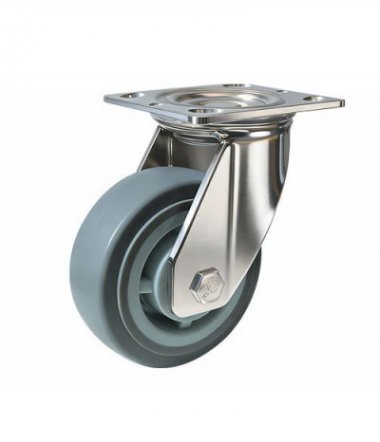
A critical detail: bolt length. If bolts are too short, they won’t secure the caster; too long, and they protrude into the equipment, creating a food trap. FFIBU provides custom bolt kits matched to equipment thickness—eliminating guesswork.
To see these principles in action, let’s walk through three common kitchen challenges—and how FFIBU casters address them:
A hotel dishroom uses a 3-tier cart to shuttle dirty plates from the dining room to the dishwasher. The old casters had hard rubber wheels that slipped on greasy floors, causing spills. Worse, their open bearings collected food debris, leading to a health code violation.
FFIBU Solution: Replace with hygienic elastomer wheels (75 Shore A) and sealed stainless bearings. The textured tread grips greasy floors, and the smooth fork wipes clean in seconds. Result: zero slips, zero violations.
A frozen food distributor uses a pallet jack to move 1,500-pound loads of frozen vegetables in a -10°F freezer. Standard casters cracked within weeks, leaving the jack immobile.
FFIBU Solution: Cold-flex polyurethane wheels with forged steel cores. The material stays flexible in extreme cold, and the core supports the heavy load. The jack now runs 18 months without replacement.
A bistro’s front-of-house mobile bar needs wheels that roll quietly, don’t scratch the oak floor, and blend with the decor.
FFIBU Solution: Non-marking TPR wheels with a brushed stainless finish. The wheels are nearly silent, leave no marks, and the sleek design complements the bar’s aesthetic.
With hundreds of caster brands globally, what makes China Zhongshan FFIBU Casters Co., Ltd a leader in foodservice? It’s their obsession with application-specific engineering:
No “One-Size-Fits-All” Solutions: Every FFIBU caster is designed for a specific kitchen zone—not repurposed from industrial or medical lines.
In-House Testing: FFIBU labs simulate 10 years of kitchen use in 6 months: rolling casters over gravel, submerging them in grease, and freezing them to -40°F.
Global Support: From Chicago to Singapore, FFIBU partners with local distributors who understand regional kitchen codes (e.g., EU’s EN 1672-2 hygiene standards).
Choosing casters for kitchen equipment is not about finding the cheapest option—it’s about investing in reliability. A 20 generic caster that fails every 12 months (and causes downtime, repairs, and violations).
For chefs, this means fewer interruptions during service. For facility managers, lower maintenance costs. For owners, compliance with health codes and happier customers. And for equipment designers, a partnership with a brand that understands the unique demands of foodservice.
When you specify FFIBU casters, you’re not just buying wheels—you’re engineering mobility that keeps your kitchen moving, no matter how intense the heat gets.
About China Zhongshan FFIBU Casters Co., Ltd
Based in Zhongshan, China, FFIBU specializes in high-performance casters for foodservice, healthcare, and industrial applications. With a focus on material innovation and hygienic design, the FFIBU brand is trusted by commercial kitchens worldwide to deliver mobility solutions that stand up to the toughest environments.
 中文简体
中文简体  English
  Español
  العربية
  Français
  Русский
  Português
  Deutsch
  日本語
日本語  한국어
한국어  Tiếng Việt
  हिन्दी
  Italiano
  Nederlands
  Türkçe
  Polski
  ไทย
ไทย  Română
  বাংলা
বাংলা  Українська
  עברית
עברית  Lietuvių
  Bahasa Indonesia
  Svenska
  Magyar
  Dansk
Dansk  Suomi
Suomi  Čeština
  Ελληνικά