Select Language
Selecting the correct caster is far more than picking a wheel that "looks right." An underspecified caster leads to premature failure, damaged floors, excessive pushing effort, or even workplace injury. A well-chosen caster improves safety, reduces operator fatigue, and extends equipment life. Below is a step-by-step guide covering load calculation, wheel material, configuration, brakes, mounting, and environment — the same methodology used by China Zhongshan FFIBU Casters Co., Ltd when engineering FFIBU caster solutions for specialized applications.
The first and most critical step is determining how much weight each caster must support.
Basic Formula:
Single Caster Load = (Equipment Dead Weight + Maximum Payload) ÷ Number of Casters × Safety Factor
Safety Factor: Typically 1.2–1.5× for manual indoor use on smooth floors; 1.5–2.0× for uneven floors, outdoor use, or powered towing.
Uneven Floor Rule of Thumb: On rough or uneven surfaces, assume only 3 wheels bear the load at any time — divide total weight by 3 (not 4) before applying the safety factor.
Example:
A trolley weighs 200 kg, carries 300 kg max load, uses 4 casters, indoor smooth floor → (200+300) ÷ 4 × 1.3 = 162.5 kg per caster minimum rated load.
✅ Always select a caster whose rated dynamic loadexceeds your calculated value. Never size based on static load alone — starting, stopping, and crossing thresholds create impact loads.
Wheel diameter affects pushing effort and obstacle clearance:
Diameter | Typical Use |
|---|---|
2"–3" (50–75 mm) | Light furniture, instrument carts (<100 kg total) |
4"–5" (100–125 mm) | Office equipment, medical carts, light-duty trolleys |
6"–8" (150–200 mm) | Workshop carts, parcel handling, medium-duty equipment |
10"+ (250+ mm) | Heavy machinery bases, heavy-duty AGV/transfer carts |
Larger diameters roll easier, overcome thresholds/cracks better, and reduce rolling resistance.
Trade-off: Oversized wheels raise the equipment's center of gravity — verify stability and mounting height clearance.
Wheel tread material determines floor protection, noise, durability, and chemical resistance.
Material | Pros | Cons | Best For |
|---|---|---|---|
Polyurethane (PU) | Floor-friendly, quiet, excellent wear, good load capacity | Can heat-buildup on continuous high-speed rolling | Warehouses, labs, FFIBU 3D printer enclosures, logistics carts |
Rubber / TPR / TPE | Very quiet, good shock absorption, grips well | Wears faster, may leave black marks | Hospitals, quiet offices, rough floors |
Nylon / Polypropylene | Extremely durable, low rolling resistance, chemical-resistant | Noisy, can mark soft floors, poor shock absorption | Smooth concrete, food/chemical plants, high-temp areas |
Cast Iron / Forged Steel | Highest load capacity | Damages floors, very noisy | Heavy-industry, rail-side, foundry settings |
Phenolic / Conductive PU | Spark-resistant, ESD-safe, chemical-resistant | Brittle in freezing temps | Electronics mfg, explosive-atmosphere zones |
💡 For FFIBU-spec 3D printer enclosures and parcel handling systems, non-marking PU on smooth floors is typically the optimal choice — balancing vibration damping, load capacity, and floor protection.
Configuration | When to Use |
|---|---|
2 Swivel + 2 Rigid | Most industrial carts — good straight-line tracking + reasonable turning |
4 Swivel | Tight spaces, frequent sideways positioning, small aisles — maximum maneuverability but may "wander" on long straight runs |
4 Rigid | Straight-line only transport on fixed tracks/guides — rarely used alone |
Directional Lock (Swivel Lock) | Converts a swivel caster to fixed mode temporarily — useful for long corridor runs |
Typical recommendation: 2 swivel (usually at the push-end, preferably with brakes) + 2 rigid (at the opposite end).
Brake Type | Function | Use Case |
|---|---|---|
Wheel Brake (Side Brake) | Locks wheel rotation only | Basic parking on level floors |
Total Lock (Dual Brake) | Simultaneously locks wheel rotation AND swivel raceway | Slopes, workstations used while stationary, precise positioning |
Swivel/Directional Lock | Locks only the swivel — wheel still rolls | Long straight pushes; pairs with wheel brakes |
No Brake | — | Equipment always moved & never left unattended on slopes |
⚠️ On any incline or when equipment is used as a stationary workstation, total-lock brakes are strongly advised for safety.
Common mounting styles:
Top Plate (most industrial): Bolted to equipment base — strongest, preferred for medium/heavy duty. Verify hole spacing (e.g., 70×58 mm, 82×71 mm, 100×80 mm) and plate size.
Threaded Stem / Grip Ring Stem: Common on furniture, light medical carts, insert into tubular legs.
Bolt-Hole (expanding sleeve): For round or square tubing — drill-free installation.
Also check:
Overall height — will it fit under your equipment?
Swivel offset / swivel radius — affects turning space needed.
Beyond load and floor, consider:
Condition | Recommendation |
|---|---|
Wet / humid / washdown | Stainless steel (304/316) brackets, zinc-plated or powder-coated forks, sealed bearings |
Cold storage (<0°C / 32°F) | Cold-resistant PU or rubber — standard nylon becomes brittle |
High temp (>80°C / 176°F) | High temp PU, phenolic, or cast iron; avoid standard rubber |
Oil / solvent / chemical | Nylon, phenolic, or chemically resistant PU — avoid standard rubber |
ESD-sensitive areas | Conductive PU or rubber with carbon fill, grounded metal brackets |
Dusty / fibrous (cardboard, textile) | Sealed or shielded bearings to prevent debris ingress |
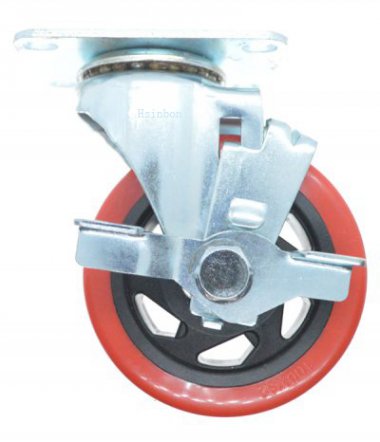
Ball Bearings: Smooth swiveling and rolling under medium loads — standard for most PU/nylon wheels.
Roller Bearings: Higher load capacity, slightly more resistance — heavy-duty applications.
Plain / Sleeve Bearings: Economical, adequate for light-duty, low-frequency use.
Sealed Bearings: Recommended for dusty or washdown environments.
Before ordering, confirm:
☑ Total weight (equipment + max load) and safety-factor-adjusted per-caster load
☑ Wheel diameter suitable for floor obstacles and ergonomics
☑ Wheel material matched to floor type and noise requirement
☑ Swivel/rigid configuration (typically 2+2)
☑ Brake type needed (wheel brake vs. total lock)
☑ Mounting plate dimensions or stem specs match your equipment
☑ Environment (temp, moisture, chemicals, ESD) addressed in bracket/wheel choice
☑ Bearing type appropriate for load and usage frequency
A caster is a small component with an outsized impact on equipment usability and safety. Whether you're outfitting a heavy parcel sortation cart, a mobile 3D printer enclosure, or a lab workbench, following the above method ensures you get the right match. For application-specific consultation and purpose-built options, China Zhongshan FFIBU Casters Co., Ltd offers technical support and the full FFIBU caster range — engineered to perform where generic wheels fall short.
 中文简体
中文简体  English
  Español
  العربية
  Français
  Русский
  Português
  Deutsch
  日本語
日本語  한국어
한국어  Tiếng Việt
  हिन्दी
  Italiano
  Nederlands
  Türkçe
  Polski
  ไทย
ไทย  Română
  বাংলা
বাংলা  Українська
  עברית
עברית  Lietuvių
  Bahasa Indonesia
  Svenska
  Magyar
  Dansk
Dansk  Suomi
Suomi  Čeština
  Ελληνικά