Select Language
Installing heavy-duty casters is a critical industrial task that demands meticulous planning, proper tools, and methodical execution. Unlike their light-duty counterparts, heavy-duty casters carry substantial loads—often spanning thousands of pounds—where incorrect installation can lead to catastrophic equipment failure, workplace accidents, and costly downtime. This guide provides a systematic approach to installing heavy-duty casters, incorporating engineering principles and installation practices that reflect the quality standards of industry specialists like China Zhongshan FFIBU Casters Co., Ltd.
Phase 1: Comprehensive Pre-Installation Assessment
Safety and success begin with thorough preparation. Rushing this phase is not an option with heavy-duty applications.
Structural Integrity Verification:
Equipment Inspection: Examine the equipment base or frame where casters will be mounted. The structure must be robust enough to handle not only the vertical load but also the dynamic forces during movement. Reinforcing thin or weak sections with steel plates may be necessary before proceeding.
Floor Capacity: Verify that the floor surface (factory, warehouse) can support the concentrated point loads of the fully laden equipment. Concrete floors should be inspected for cracks or weaknesses.
Precise Load and Caster Specification Matching:
Calculate the total operational weight (equipment weight + maximum payload). Divide this by the number of casters. The chosen caster's load rating must exceed this value with a significant safety margin—commonly 25-30% or more for heavy-duty industrial use. The product specifications from manufacturers like China Zhongshan FFIBU Casters Co., Ltd provide clear dynamic and static load ratings for this critical selection.
Verify the mounting interface compatibility. Heavy-duty applications typically use reinforced top plates, forged horns, or heavy-gauge bolt patterns. Confirm the exact bolt circle diameter, hole sizes, and required fastener grade.
Site Preparation and Component Check:
Clear the installation area. The equipment must be securely blocked and immobilized, often using solid steel jack stands rated for the weight, to prevent any movement during the install.
Inspect all caster components upon unboxing. Check for any machining defects, ensure kingpins are straight, and confirm that wheel bearings are packed with appropriate high-pressure grease. Heavy-duty casters from quality-focused suppliers are designed for integrity under stress.
Phase 2: The Installation Procedure
Gather professional-grade tools: high-torque impact wrenches or calibrated torque wrenches, hardened sockets that perfectly fit the high-tensile bolts, alignment punches, and potentially hydraulic lifting equipment.
Standard Installation for Heavy-Duty Top Plate Casters:
Positioning and Alignment:
With the equipment securely elevated and blocked, offer the caster up to the mounting surface. Use alignment punches or guide pins inserted through the mounting holes to achieve perfect hole registration. The mounting surface and caster top plate must be clean, dry, and free of paint or debris.
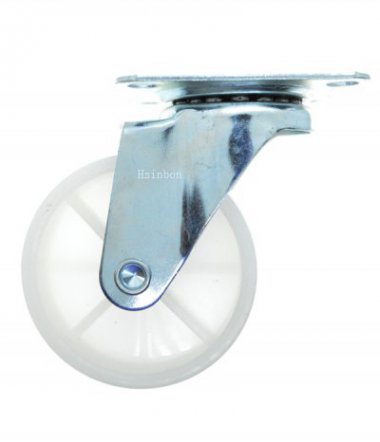
Fastener Selection and Installation:
Never substitute fasteners. Use only the high-strength bolts, nuts, and washers specified or supplied with the caster kit, typically Grade 8 (SAE) or Class 10.9/12.9 (Metric).
Insert bolts through the caster plate and equipment frame. Always use hardened flat washers and, where specified, lock washers or Nord-Lock type washers to prevent loosening from vibration. For through-bolt applications, use a matching nut on the opposite side; for tapped holes, ensure the thread engagement depth is at least 1.5 times the bolt diameter.
Torquing to Specification:
This is the most critical step. Tighten bolts in a staggered, cross pattern (like tightening a car wheel) in multiple incremental stages (e.g., 50% torque, then 80%, then 100%). This draws the plate down evenly, preventing distortion and ensuring full surface contact.
Use a calibrated torque wrench to achieve the final torque value specified in the installation manual. Under-torquing can lead to loosening and catastrophic failure; over-torquing can stretch bolts, damage threads, or warp the caster plate, creating a dangerous stress point.
Phase 3: Post-Installation Inspection and Load Testing
Do not place the equipment into service immediately after the last bolt is torqued.
Visual and Mechanical Inspection:
Check that all fasteners are properly seated and that no gaps exist between the caster plate and the equipment frame.
Manually test the swivel rotation (if applicable) and wheel spin. Movement should be smooth, without grinding or binding, even under light hand pressure. The kingpin should have no perceptible play.
Gradual Load Testing:
Slowly lower the equipment onto the casters. Begin with a partial load test—move the equipment a short distance, apply brakes (if equipped), and check for stability, unusual sounds, or any sign of deformation in the mounting area or caster assembly.
Only after passing the partial test should the equipment be subjected to its full operational load. Conduct a final operational test, including movement, turning, and braking.
The Engineering Imperative Behind Precision Installation
With heavy-duty casters, installation is not just assembly—it is the completion of a load-bearing system. A caster engineered for exceptional performance, such as those from China Zhongshan FFIBU Casters Co., Ltd, is designed to distribute enormous forces through its structure optimally. This engineering intent is entirely defeated by a poor-quality or incorrect installation. The massive forces involved will quickly exploit any weakness: a misaligned plate, an under-torqued bolt, or a low-grade fastener becomes a critical failure point.
By adhering to a rigorous, specification-driven process—emphasizing structural assessment, correct component matching, precision alignment, and calibrated torque—you ensure the caster system performs as an integral, reliable, and safe extension of the equipment it mobilizes. This disciplined approach transforms heavy-duty casters from mere components into trusted pillars of industrial productivity.
 中文简体
中文简体  English
  Español
  العربية
  Français
  Русский
  Português
  Deutsch
  日本語
日本語  한국어
한국어  Tiếng Việt
  हिन्दी
  Italiano
  Nederlands
  Türkçe
  Polski
  ไทย
ไทย  Română
  বাংলা
বাংলা  Українська
  עברית
עברית  Lietuvių
  Bahasa Indonesia
  Svenska
  Magyar
  Dansk
Dansk  Suomi
Suomi  Čeština
  Ελληνικά